Time savings:
Inventory counts take significantly less time.

Automated inventory with AI
Why are traditional inventories so time-consuming?
Traditional inventory counts are time-consuming and prone to errors. They require numerous employees, who often spend several days manually counting and documenting inventory. This leads to inaccurate results, operational disruptions, and delayed processes – even though inventory is required by law and is essential for transparency and inventory accuracy. abat shows how this conflict of objectives can be resolved using AI and drone technology.
How can AI make inventory taking at off-site warehouses more efficient?
The combination of AI-powered image recognition and modern drone technology significantly automates the inventory process. A process that previously required several people and workdays can now be carried out by a single person using a drone. The employee launches a pre-planned autonomous drone flight, and the artificial intelligence then calculates the inventory.
- Efficient counting of pallets in the outdoor warehouse: Using predefined flight routes, the drone captures images of the pallets in the outdoor warehouse from various perspectives (bird’s-eye view, top view, side view). The different angles enable reliable detection and minimize errors caused by obstructions.
- AI-powered inventory calculation: The images captured by the drone are analyzed by AI software. Using object recognition and counting, the software determines the number of storage units, identifies different types, and even assesses the loading status. Based on information stored in the inventory management system, the AI can calculate the total inventory and the value of the stored goods.
- Precise location tracking with GPS technology: The drones use GPS in conjunction with image recognition to determine the exact location of products on the company premises with centimeter-level accuracy. This information can be used to optimize warehousing and logistics processes.
- Seamless integration into existing systems: The data collected through drone inventory is integrated directly into the enterprise resource planning (ERP) system, creating an automated and digital workflow and eliminating the need for manual data entry.
- Minimization of labor requirements: A process that used to take an entire team several days to complete can now be carried out by a single person using a drone. This frees up employee resources that can be allocated to more value-added tasks.
How can inventory in outdoor open-air storage yards be automated?
abat has developed an AI-based inventory solution that largely automates the manual counting process. Drones capture images of the warehouse from the front and a bird’s-eye view, while AI models use the captured images to automatically recognize, classify, and count pallets and products – without the need for RFID tags or manually walking through the warehouse.
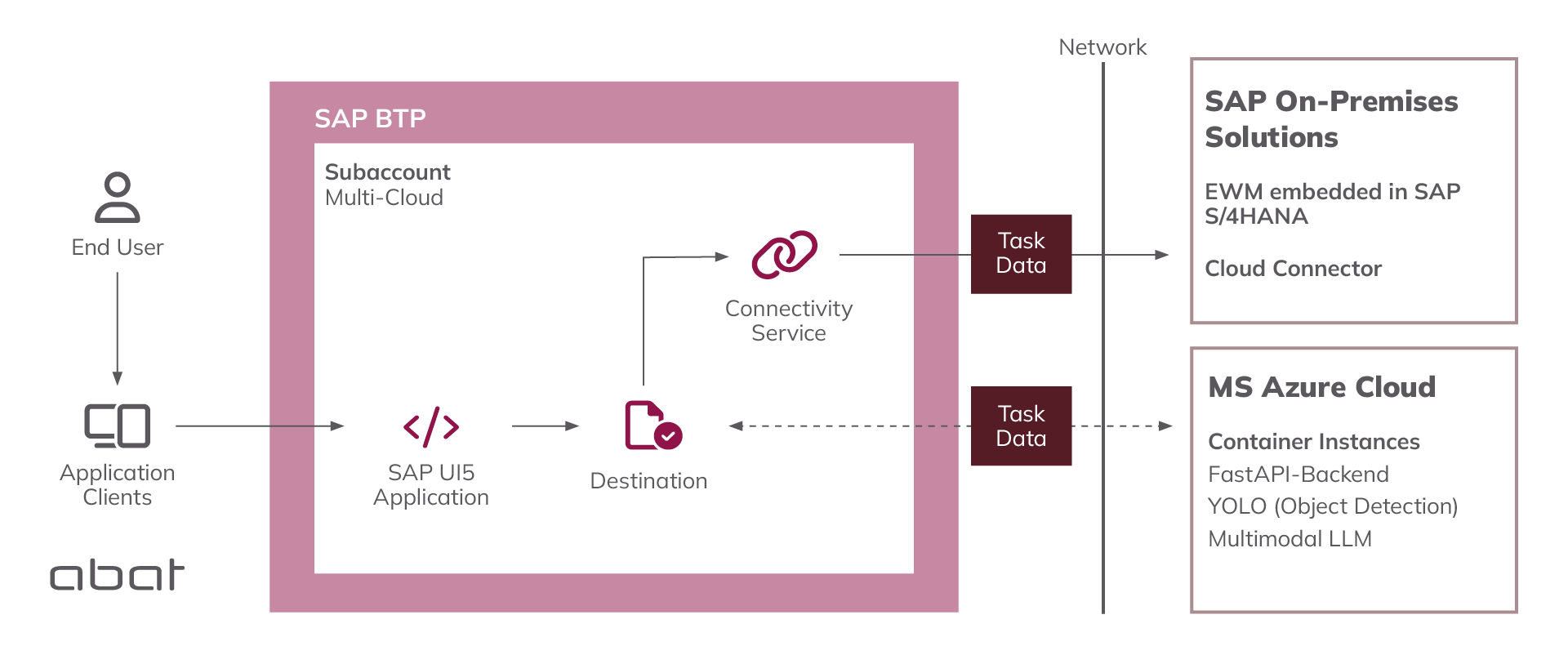
The solution accounts for real-world warehouse conditions and combines multiple perspectives to reliably capture even stacked inventory. The results are documented, presented in a traceable format, and can be integrated directly into SAP-based inventory processes. This creates a digital inventory with visual verification, high accuracy, and minimal staff involvement.
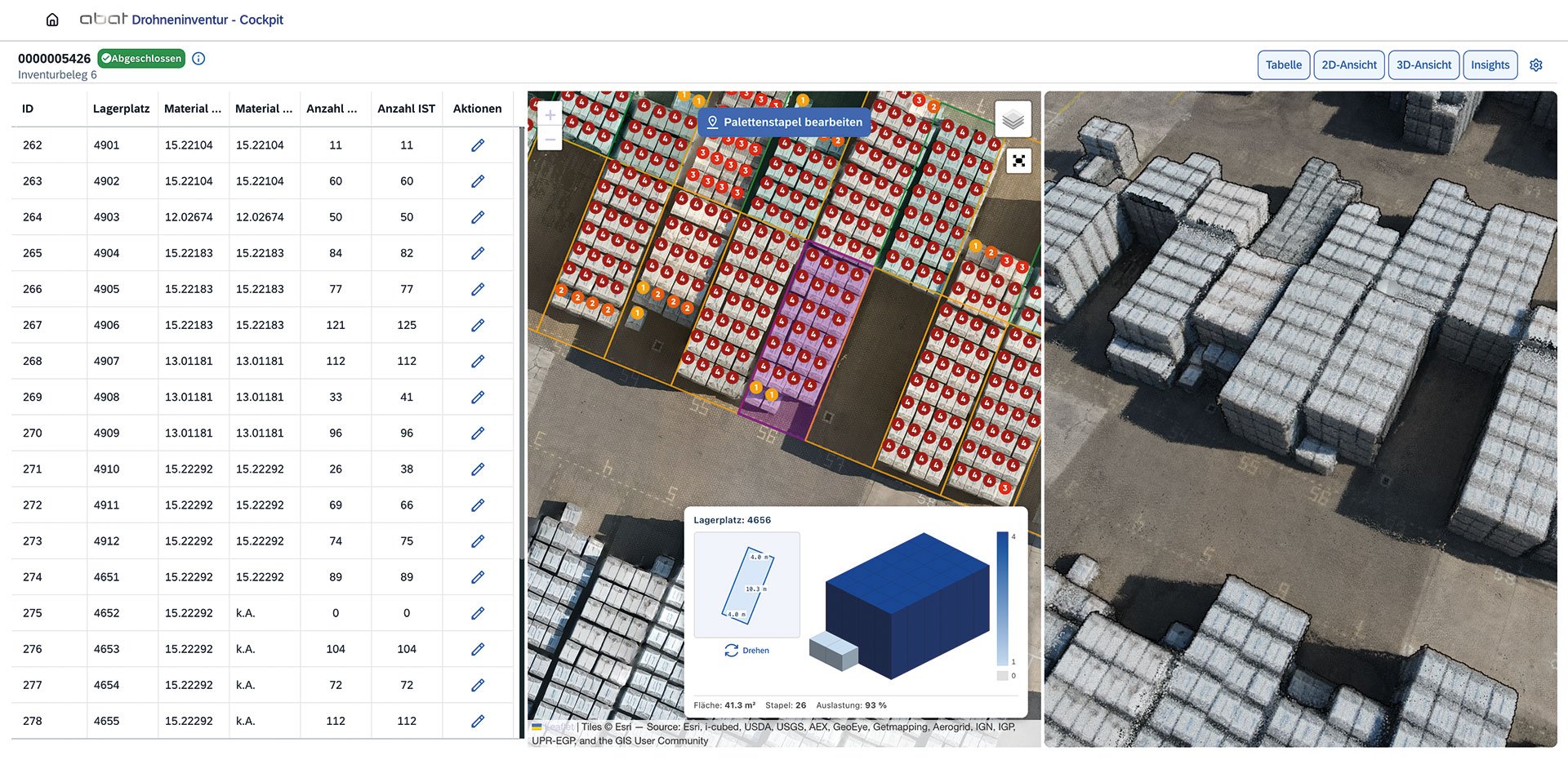
In practice, the added value is clear: instead of multiple counting teams, a single drone operator is sufficient. The effort required for inventory is reduced by up to 90%, while transparency, repeatability, and data quality increase simultaneously.
For analysis, the inventory cockpit combines the drone imagery with a digital twin of the warehouse. The count results are assigned to the respective storage locations both in tabular and graphical form. This allows the results to be verified immediately and, if necessary, corrected with just a few clicks. An integrated 3D model also documents the current warehouse status and visualizes the exact stacking of individual blocks.
AI counts, SAP posts: Automated inventory processes
Whether cables, pipes, or long materials: In practice, taking inventory of storage locations with high quantities is particularly labor-intensive. Manual counting is time-consuming, error-prone, and simply tedious for employees. Especially with cantilever racks containing several thousand units per storage location, traditional inventory processes quickly reach their limits.
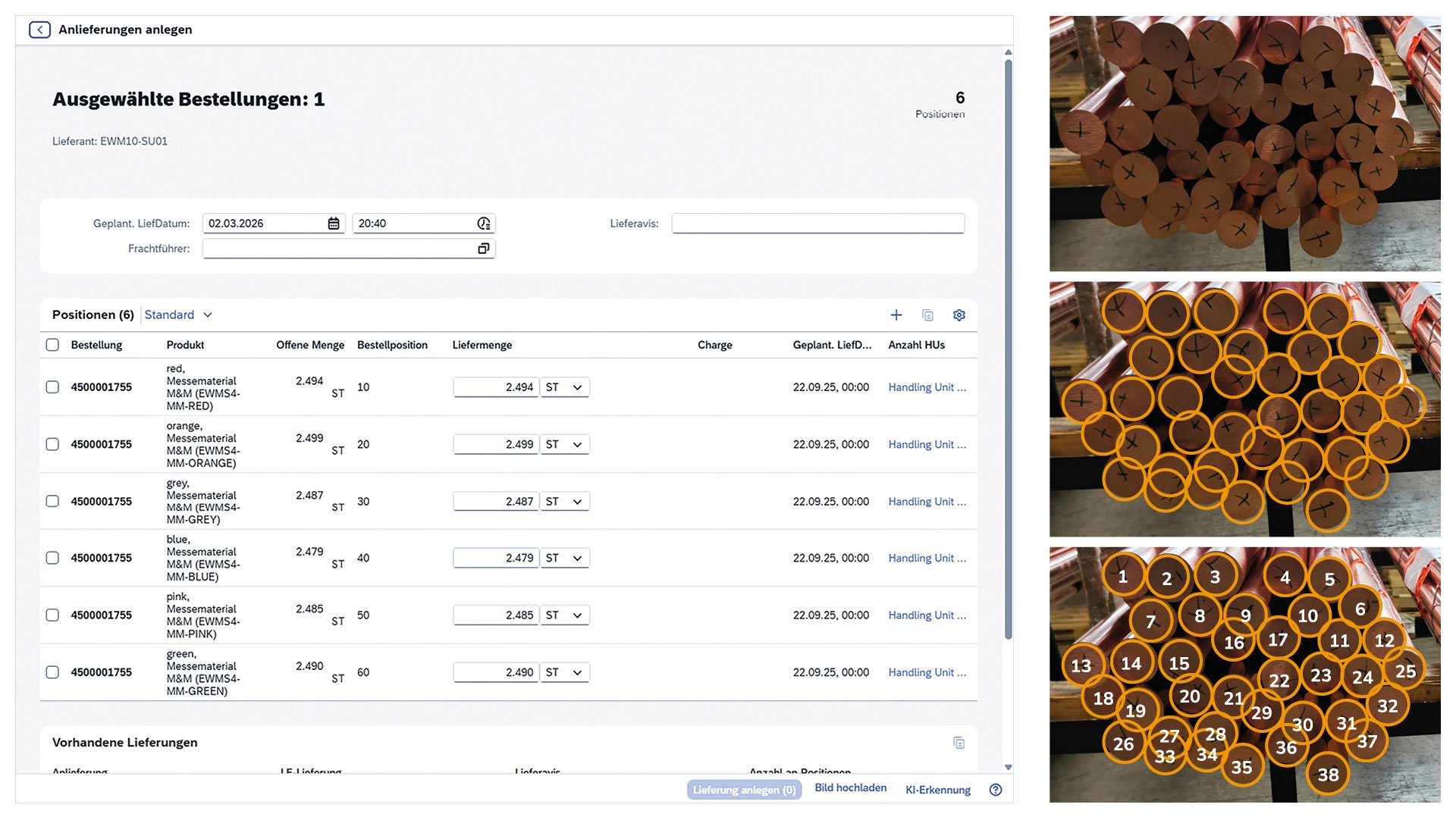
abat has therefore developed an AI-based solution for mobile inventory capture that reduces counting to a minimum. The process is simple and practical: The storage location is recorded using a handheld device or mobile terminal; a photo is then taken and sent to the AI. The AI analyzes the image, recognizes the stored objects, and automatically counts even very large quantities – for example, several thousand pipes at a single storage location.
The determined inventory is then transferred directly to SAP, where it can be used for inventory counts, inventory adjustments, or other logistics processes. Manual counting, recounting, or estimating can be completely eliminated.
This approach can be used not only for inventory but also for goods receipt. Here, too, delivered materials can be captured via photo, automatically counted, and immediately posted. This creates a reliable, digitally recorded inventory as soon as the goods arrive – quickly, easily, and without additional manual effort.
The solution is particularly well-suited for cantilever racks and storage locations containing homogeneous materials that are difficult to count. It integrates seamlessly into existing warehouse processes and ensures faster inventory counts, higher data quality, and a significant reduction in the workload for employees – without the need for additional hardware or complex system upgrades.
How do you keep track of your returnable container inventory in real time?
Empty container processes are complex and fast-paced: Different types of bottles, changing container sizes, and high throughput rates make it difficult to accurately track inventory. Manual spot checks provide only limited insight.
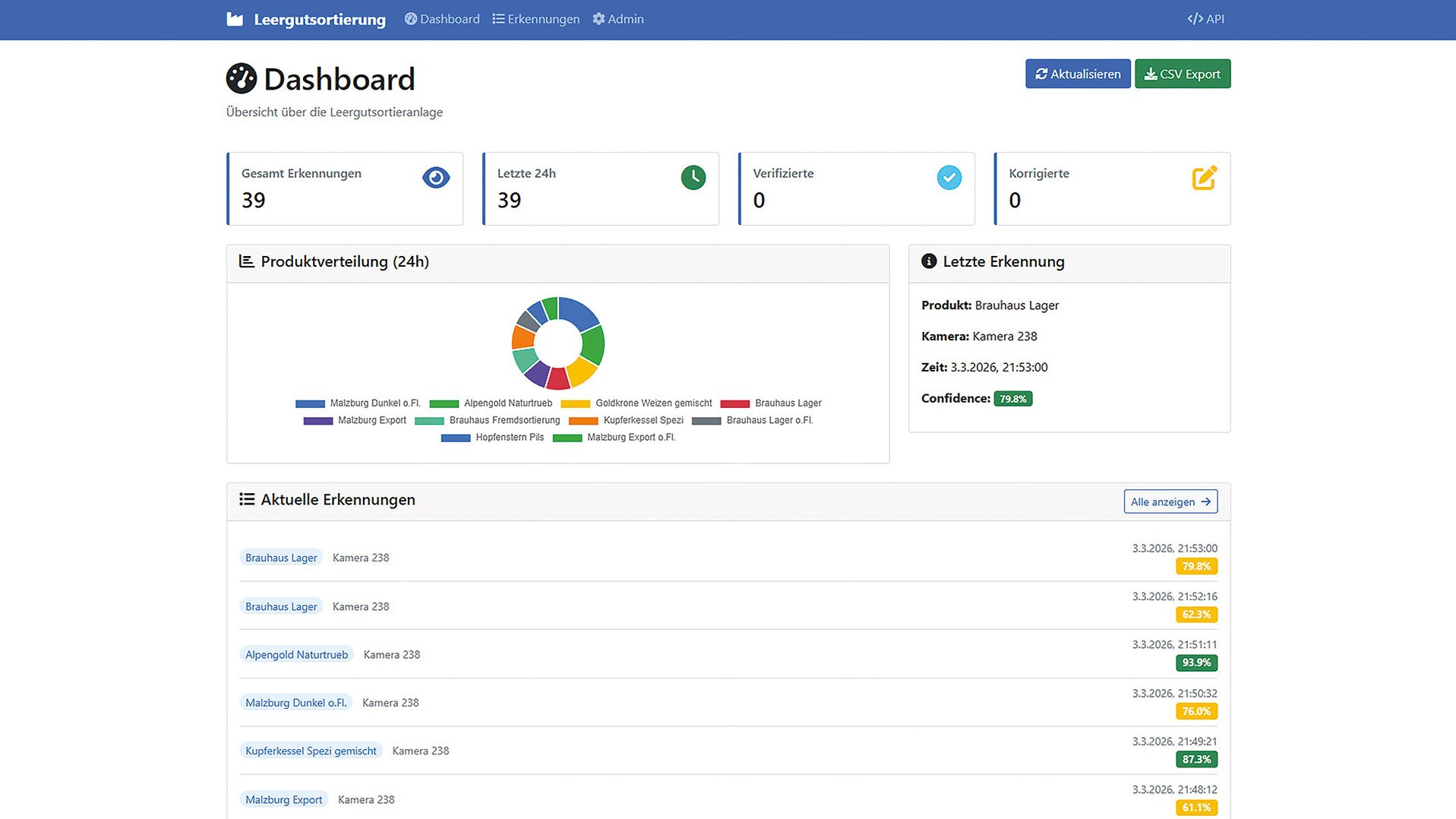
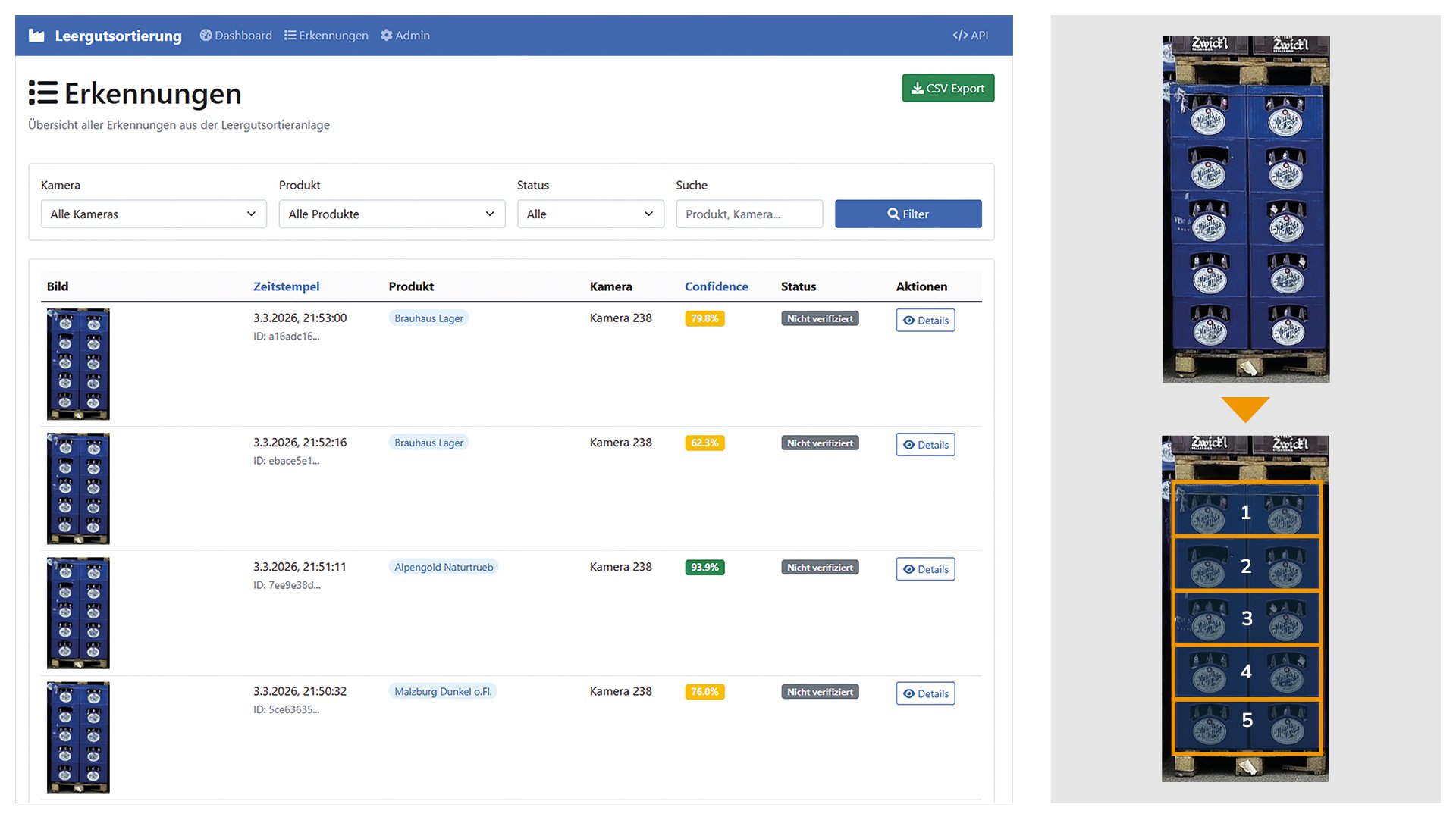
For a brewery, abat has implemented an AI-powered solution for automated empty container tracking. Fixed industrial cameras along the empty container sorting line capture each pallet in real time as it leaves the line. The AI identifies which product is on the pallet, whether it contains the correct bottles, and how high the pallet is stacked. The information is visualized in a central tool and can be transferred directly to SAP systems on a scheduled or event-driven basis.
The result: significantly improved inventory quality, high transparency along the returnable container lines, and a reliable basis for decision-making. The solution is scalable and can be applied to additional returnable container lines or comparable use cases in intralogistics.
Key benefits at a glance
- Real-time detection of returnable pallets with product and quality inspection
- Significantly higher inventory quality and full transparency
- Scalable and integrable with SAP for multiple lines and locations
Advantages and benefits
Greater accuracy:
Counting errors are greatly reduced compared to manual counting.
Cost reduction:
Fewer staff, fewer errors, faster processes.
Safety:
Drones handle risky tasks in hard-to-reach areas.
Flexible use:
Immediately usable for spontaneous, regular, or one-time inventory counts.
Improved inventory management:
Precise location data enhances organization and administration.
Make your next inventory the last one done manually
How many person-days does your inventory count cost you today? Talk to us – we’ll show you which of the three methods (drone, photo, camera) is right for your warehouse.

You might also be interested in
Inventory solution with AI
Our SMARTsolution
Inventory from a bird's eye view
White Paper
Smart Manufacturing
Our SMARTsolution
AI-based stocktaking
our video
Frequently asked questions about automated inventory
Is drone inventory audit-proof?
Yes – every count is documented with visual evidence and presented in a traceable format. The results can be integrated directly into SAP-based inventory processes; the inventory dashboard allows for verification and correction with just a few clicks.
Do we need RFID tags or special labels?
Which approach is suitable for which types of warehouses?
How are the count results transferred to our SAP system?
Contact our AI experts
Europe


China

North America