
Transport Management in Cloud ERP download white paper now
Transport Management in Cloud ERP
What the transport standard in SAP Cloud ERP delivers and where it ends
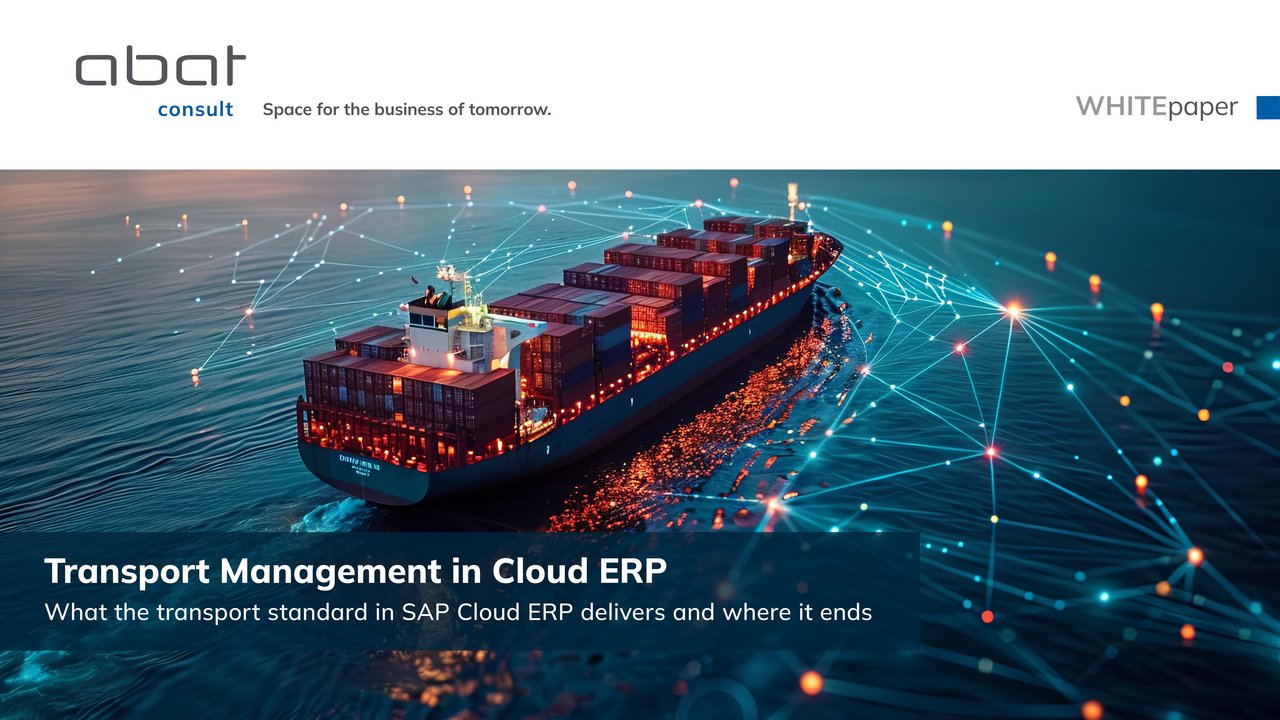
Your move to S/4HANA is decided. What remains open is whether your transportation processes fit into the public cloud. Our white paper “Transport Management in Cloud ERP” shows what the SAP Cloud ERP standard delivers, where it ends, and how the gaps can be closed: from planning in the transportation cockpit to freight costs, interfaces, and outsourced route planning. Five questions show logistics and IT leaders whether the standard supports their processes before go-live provides the answer.
FAQs:
1. How can we tell whether Cloud ERP can support our logistics?
By five checks, not by a percentage: Do you need automatic route optimization? Freight tendering? Does your rate structure go beyond the available calculation bases? Do you settle toward ordering parties or between your own companies? And are the transportation scope items missing in one of your rollout countries? Five times no means: the standard basically supports your processes. If the answer to one or more is “yes,” you check whether the gap can be closed with a second, planning system (scope item 6W1) or whether SAP TM in Private Cloud or on-premises is the better route.
2. Which functions are missing in the transport standard of Cloud ERP?
3. Can we add automatic route optimization later?
4. Is it true that IDoc, RFC, and BAPI are dropped completely?
5. What does the clean core principle mean for extensions?
6. How far does freight cost settlement go in Cloud ERP?
Contact our expert