
SAP Agent-Led Toolchain: What’s changing and what’s already working today

At SAP Sapphire in May 2026, SAP renamed the Integrated Toolchain to the Agent-Led Toolchain. The new name reflects a vision: AI agents are intended to support transformation projects throughout all phases. For decision-makers, this raises a practical question: What is really changing, what remains the same, and what can already be used today? 

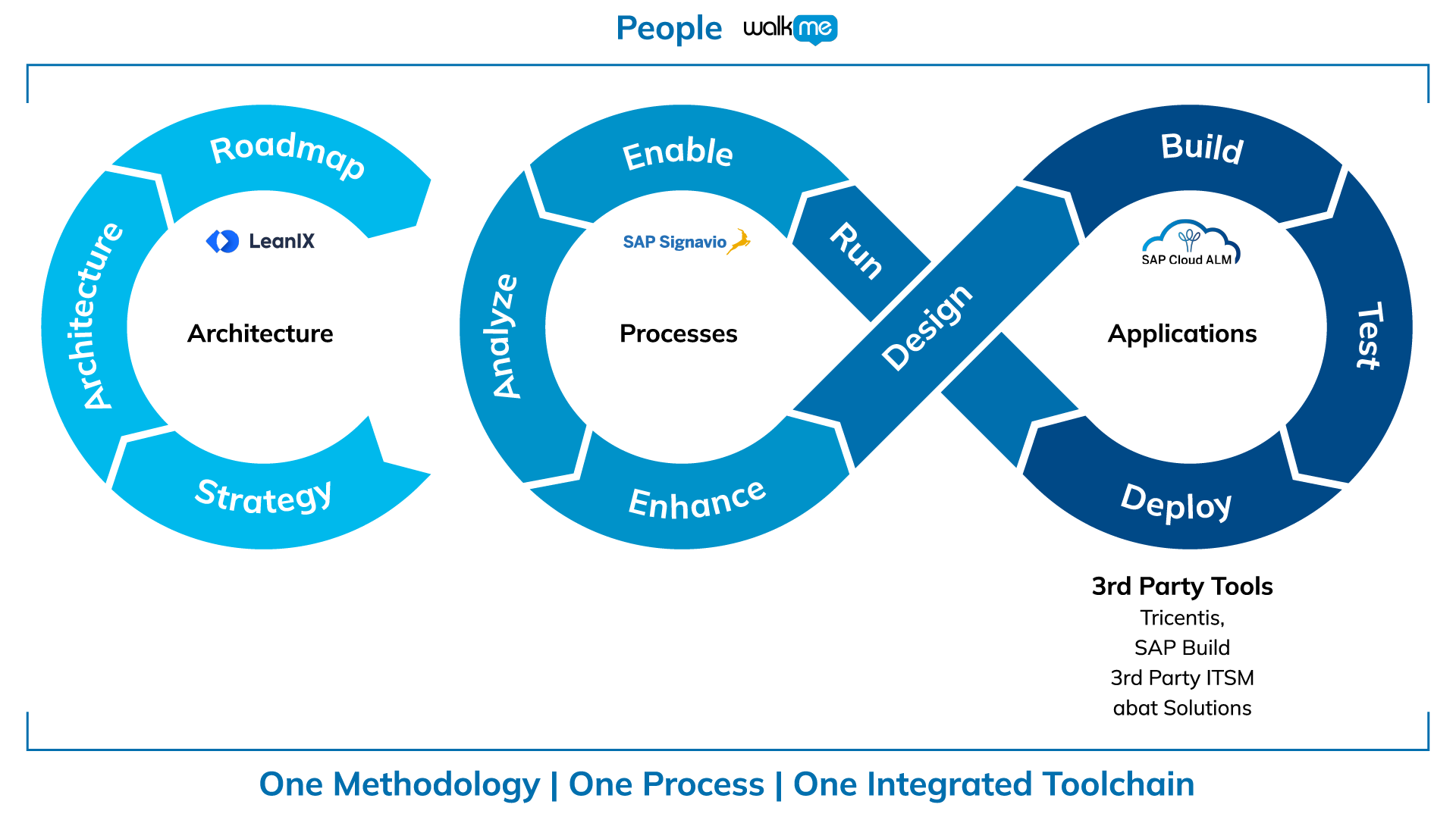
In short: The SAP Agent-Led Toolchain is an evolution of the SAP Integrated Toolchain, not a new product suite. The tools remain the same: SAP LeanIX, SAP Signavio, and SAP Cloud ALM, supplemented by partner solutions such as Tricentis and Syniti. What’s new is an AI layer consisting of Joule Assistant and Joule Agents, which coordinates and executes tasks across these tools. For migration and modernization, SAP has announced seven AI assistants for 2026. 

In this article, we’ll break down the new features and outline the prerequisites that companies should clarify before implementation. Then we’ll get specific: Using an example from SAP Cloud ALM, we’ll show how AI is already generating structured requirements from a workshop transcript today.

What is the SAP Agent-Led Toolchain?

The SAP Integrated Toolchain was never a single product. It is a framework defined by SAP as part of RISE with SAP that connects enterprise architecture management, process management, and application lifecycle management. Methodologically, it guides transformation projects through the phases Discover, Prepare, Explore, Realize, Deploy, and Run. 

This is exactly where the Agent-Led Toolchain comes in. SAP refers to it as a new name for the same mission, now enhanced with AI agents across all phases and tools. According to SAP Help, the core remains unchanged: SAP Cloud ALM as the operational foundation, SAP LeanIX and SAP Signavio as the portfolio for Business Transformation Management, and Tricentis and Syniti as key delivery partners. 

SAP distinguishes between two complementary approaches:

  • Business Transformation: end-to-end management of processes, architecture, and projects with ongoing value realization, even after go-live. 
  • Migration and Modernization: AI-supported migration from legacy ERP systems such as SAP ECC to SAP S/4HANA, with the goal of reducing effort and risk. 

Our take: The term “agent-led” sounds like autopilot. But it means something else. The agents form a new execution layer on top of the existing tools. Business decisions, data responsibility, and project management remain with the people involved in the project.

What stays the same, and what’s new?

The transition is an evolution, not a replacement. The following overview shows where things are changing and where they are not. 

Dimension Integrated Toolchain Agent-Led Toolchain 
Strategic FrameworkRISE with SAP and SAP Activateunchanged 
Core ToolsSAP LeanIX, SAP Signavio, SAP Cloud ALMunchanged 
Leading Systems LeanIX for architecture, Signavio for processes, Cloud ALM for requirements and implementationunchanged; agents will not become a new leading system 
InteractionIntegrations, object mappings, defined data transfers plus AI-powered coordination via Joule
GovernanceQuality gates, roles, human reviewplus permissions, observability, and approval limits for agents
AvailabilityDepends on license and setupWizards announced for 2026; to be reviewed based on product status, tenant, contract, and license

The roles of the three core tools remain clearly separated. This is important because agents are only as good as the data they access.

  • SAP LeanIX stands for Enterprise Architecture Management. It documents the application landscape, technologies, and dependencies. Without this transparency, any system analysis lacks a foundation.
  • SAP Signavio stands for process analysis and process modeling. Signavio process models are used in SAP Cloud ALM to create the processes to be implemented – and, according to SAP, test cases will also be generated from them.
  • SAP Cloud ALM manages implementation, testing, traceability, and operations. According to SAP, all seven announced wizards run on Cloud ALM as their operational foundation.

The integration between the tools is real but selective. Some objects are synchronized, while others are connected only via defined data transfers. For decision-makers, this means that a clean data foundation across all three tools is a prerequisite – not the result – of the Agent-Led Toolchain.

Joule Assistant and Joule Agents: Who does what?

SAP distinguishes between two levels in the Agent-Led Toolchain (SAP Help): 

  • Joule Assistant (Experience Layer): This is the role-based interface for users. It understands a request, selects appropriate agents, tools, and skills, and delegates the work. 
  • Joule Agents (Execution Layer): These are task-specific specialists embedded in processes and data. They plan and execute multi-step tasks, collaborating with other agents as needed. One example is the SAP Signavio Process Consulting Agent, which analyzes business processes using natural language. 

This separation is more than just an architectural issue. It transforms a single chat interface into an orchestration layer behind which specialized units operate. However, the quality of the result continues to depend on available data, permissions, and clearly defined boundaries.

The seven assistants for migration and modernization

At the heart of the migration initiative are seven AI assistants that SAP announced at Sapphire 2026. Each assistant combines multiple AI skills and agents to address a specific transformation challenge. According to SAP, all of them run on SAP Cloud ALM and are orchestrated via Joule (SAP Community).

AssistantTask according to SAP 
System Analysis AssistantAnalyzes the existing SAP landscape, including data, customizations, and custom code, and creates the data foundation for all other assistants. 
Data Management AssistantSupports data quality and data migration, for example by identifying and resolving inconsistencies.
Custom Code AssistantChecks whether ECC in-house developments are executable in SAP S/4HANA, analyzes extensions semantically, and recommends Clean Core approaches.
Configuration and System Setup AssistantSupports system setup and design by evaluating the current and target states of the configuration.
Test Management AssistantDefines the scope of testing, generates test cases from Signavio process models and requirements, and hands off automated execution to Tricentis. 
Rollout AssistantSupports global rollouts through comparison with the template and automated localization.
Project Management AssistantAssists with project planning and management by providing guidance and decision support.

As of October 2026: SAP has announced the seven assistants for 2026. However, the availability of individual assistants may vary depending on product status, tenant, contract, and license and should be verified before making concrete plans. SAP is developing additional agents for the Business Transformation stream.

SAP states that its goal is to reduce the transformation effort by up to 35 percent (SAP FAQ). This is a manufacturer’s claim, not an independently validated average value.

What decision-makers should clarify before implementation

Agents only accelerate what has already been set up properly. Five factors determine whether the agent-led toolchain will be successful in your project:

  • Data foundation: Well-maintained architecture data in LeanIX, up-to-date process models in Signavio, and structured requirements in Cloud ALM form the foundation. Incomplete data leads to poor agent results. 
  • Human approval: SAP requires a subject-matter review of AI-generated process models, test cases, and data mappings before they are considered official project artifacts (SAP Help). This requires designated responsible parties and quality gates.
  • Permissions and security: Agents access data and tools. Rights based on the principle of least privilege, traceable logs, and clear approval limits must therefore be in place before the first pilot. 
  • Clean core and integration: The more agents work across systems, the more important it becomes to use approved interfaces and extensions on the SAP Business Technology Platform (SAP BTP) rather than making modifications to the core. 
  • Contract and availability: According to SAP, the agent-led toolchain is tied to RISE with SAP. Which cloud ALM and AI features are available – and whether AI Units are required for them – depends on the specific product, contract, and tenant. This should be clarified early on. 

The good news: None of these points need to wait until the assistants are launched. Those who organize their data, roles, and approvals now will reap the benefits sooner. And some AI features can already be used today. 

Practical example: Generating requirements from the fit-to-standard workshop using AI

Until the assistants are available, it’s worth taking a look at an AI feature that already exists in SAP Cloud ALM: AI-powered requirements generation. It generates structured business requirements from transcripts of “Fit-to-Standard” workshops. To do this, a large language model analyzes the conversation content and populates a requirements template. According to SAP, the feature also draws on content from SAP Activate and SAP Best Practices to generate solution proposals (SAP). 

Background: In “Fit-to-Standard” workshops, consultants and business users work together to verify whether the SAP standard process meets the company’s requirements. Any deviations are documented as requirements in SAP Cloud ALM. SAP has previously recommended having two experts in the workshop for this purpose: one person leads the demo, while the second documents the process. It is precisely this documentation work that the AI feature addresses. 

Initial situation

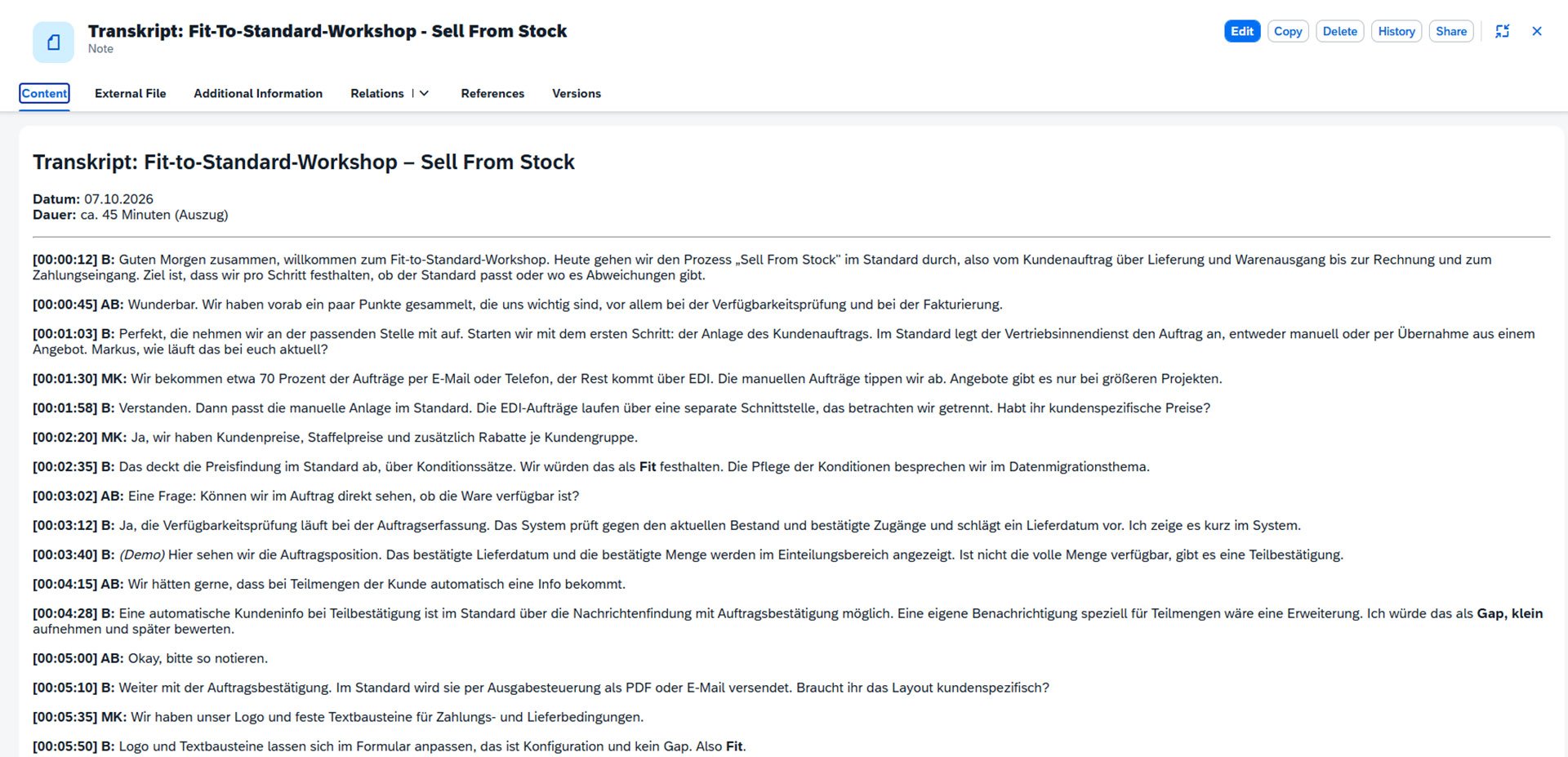
We tested the feature in our own Cloud ALM tenant. The basis was a fictional transcript of a “Fit-to-Standard” workshop on the “Sell from Stock” process – that is, warehouse sales from the sales order through delivery and goods issue to the invoice and receipt of payment. We first created the transcript as a document in SAP Cloud ALM. 

Figure 1: The fictional transcript as a document in SAP Cloud ALM. For each process step, the consultant notes whether the standard fits (Fit) or if there is a deviation (Gap).

Procedure

For the feature to be available, it must be enabled for the tenant. Which Cloud ALM and AI features are available – and whether AI Units are required for them – depends on the specific product, contract, and tenant. Once the feature is active, users can create a requirement manually as usual or have it generated by AI.

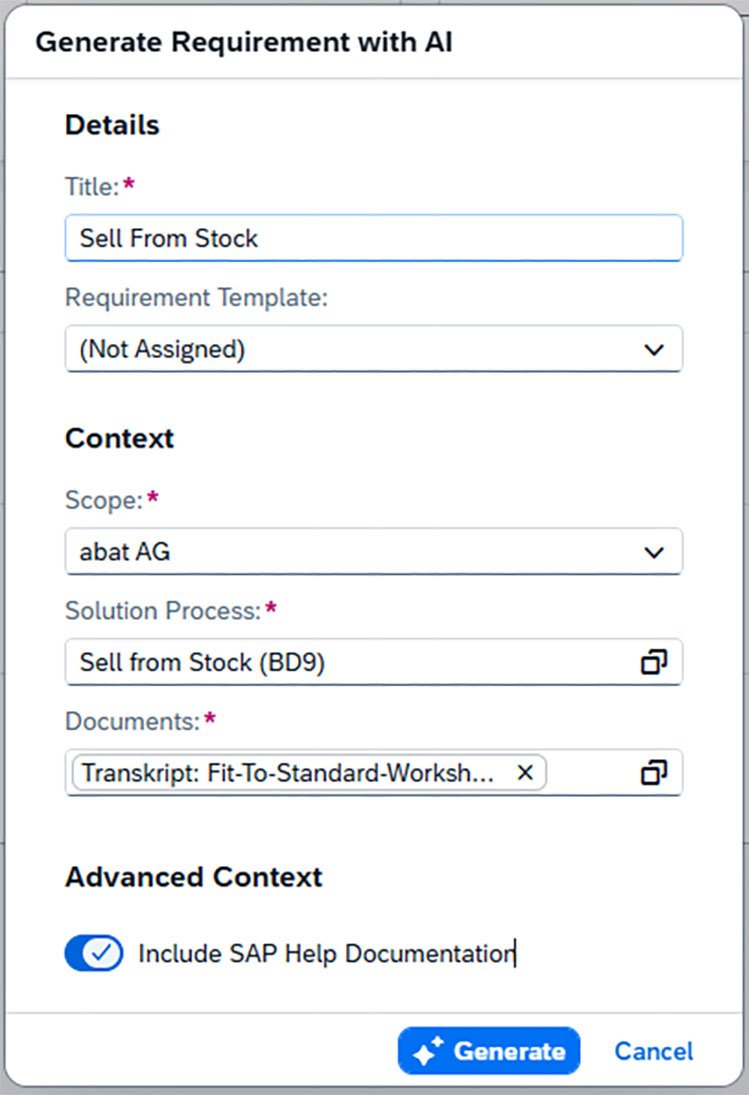
In the “Generate Requirement with AI” dialog, the title, scope, associated solution process, and the transcript are specified as a document. Optionally, a requirement template can be assigned, and the SAP help documentation can be included. In our test, no template was assigned, and the SAP help documentation was enabled.

Figure 2: The dialog for AI-assisted requirement creation. The transcript is selected as a document.

Result

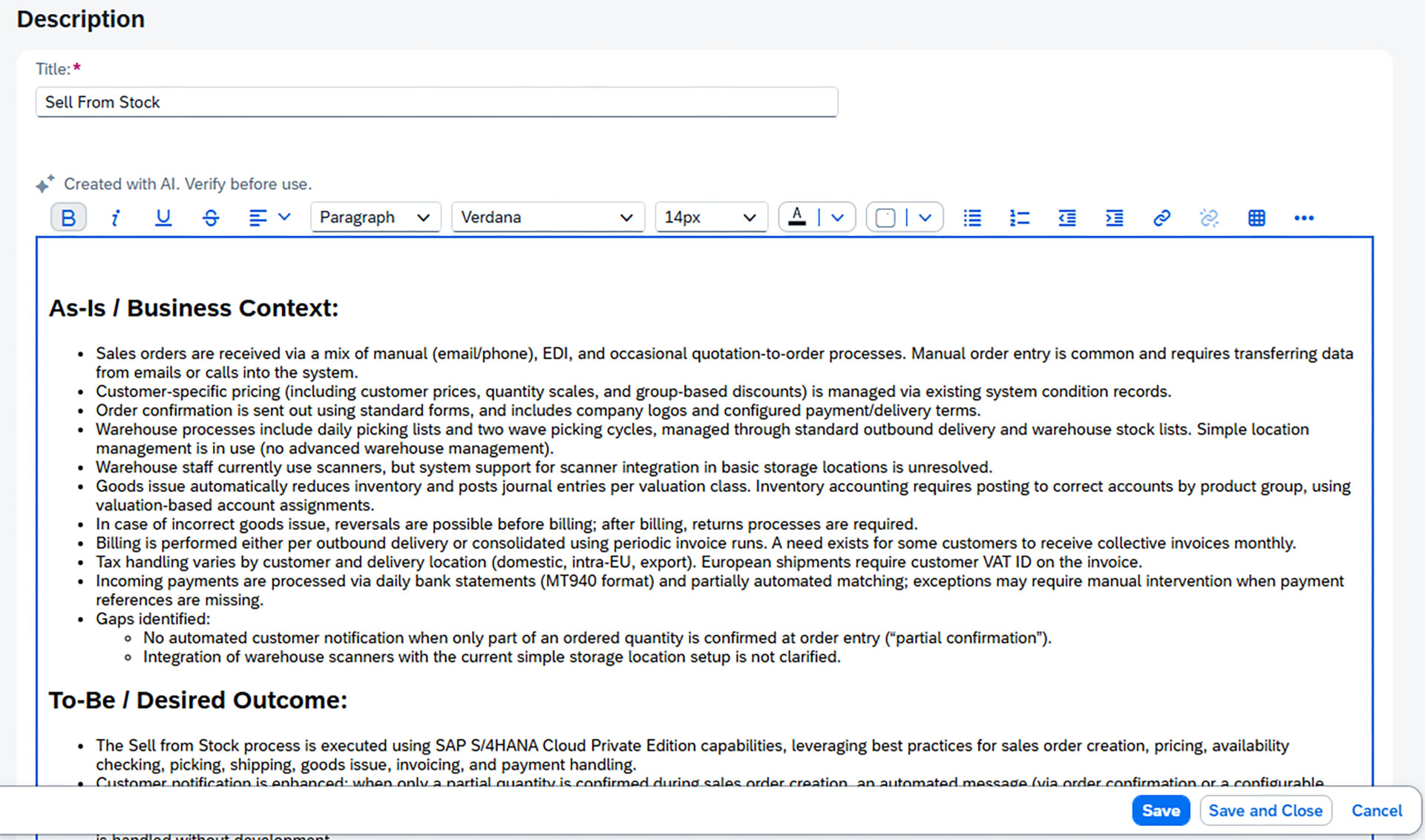
After a brief processing period, the requirement opens with a structured description. The “As-Is / Business Context” section summarizes the current situation, such as order receipt via email, phone, and EDI; customer-specific prices with tiered rates and group discounts; and order confirmations via forms featuring the company logo. Below that, the AI lists the identified gaps. These include the lack of automatic customer notification upon partial confirmation, which was classified as a minor gap in the workshop. The “To-Be / Desired Outcome” section describes the target state. 

Figure 3: The generated requirement. SAP labels the content with “Created with AI. Verify before use.”

Context

This example illustrates where the AI’s strengths lie: It summarizes a lengthy conversation, organizes the content into a consistent structure, and incorporates the fit-gap classifications from the workshop. The consulting team receives a complete draft instead of a blank form.

It also clearly demonstrates why verification is still necessary. The requirement was generated in English, even though the transcript is in German. In the target output, the AI mentions “SAP S/4HANA Cloud Private Edition,” a term that does not appear in the transcript excerpt shown. Such details must be verified against the project context before the requirement is saved. SAP itself claims a 50 percent time savings in requirements creation. This is a manufacturer’s claim.

On a small scale, this already illustrates the principle of the Agent-Led Toolchain: The AI creates the draft, a human reviews and approves it, and the result is stored in a structured format in the SAP Cloud ALM system. From there, requirements can later feed into further steps, such as test case generation by the Test Management Assistant. 

Initial situation

We tested the feature in our own Cloud ALM tenant. The basis was a fictional transcript of a “Fit-to-Standard” workshop on the “Sell from Stock” process – that is, warehouse sales from the sales order through delivery and goods issue to the invoice and receipt of payment. We first created the transcript as a document in SAP Cloud ALM. 

Figure 1: The fictional transcript as a document in SAP Cloud ALM. For each process step, the consultant notes whether the standard fits (Fit) or if there is a deviation (Gap).

Procedure

For the feature to be available, it must be enabled for the tenant. Which Cloud ALM and AI features are available – and whether AI Units are required for them – depends on the specific product, contract, and tenant. Once the feature is active, users can create a requirement manually as usual or have it generated by AI.

In the “Generate Requirement with AI” dialog, the title, scope, associated solution process, and the transcript are specified as a document. Optionally, a requirement template can be assigned, and the SAP help documentation can be included. In our test, no template was assigned, and the SAP help documentation was enabled.

Figure 2: The dialog for AI-assisted requirement creation. The transcript is selected as a document.

Result

After a brief processing period, the requirement opens with a structured description. The “As-Is / Business Context” section summarizes the current situation, such as order receipt via email, phone, and EDI; customer-specific prices with tiered rates and group discounts; and order confirmations via forms featuring the company logo. Below that, the AI lists the identified gaps. These include the lack of automatic customer notification upon partial confirmation, which was classified as a minor gap in the workshop. The “To-Be / Desired Outcome” section describes the target state. 

Figure 3: The generated requirement. SAP labels the content with “Created with AI. Verify before use.”

Context

This example illustrates where the AI’s strengths lie: It summarizes a lengthy conversation, organizes the content into a consistent structure, and incorporates the fit-gap classifications from the workshop. The consulting team receives a complete draft instead of a blank form.

It also clearly demonstrates why verification is still necessary. The requirement was generated in English, even though the transcript is in German. In the target output, the AI mentions “SAP S/4HANA Cloud Private Edition,” a term that does not appear in the transcript excerpt shown. Such details must be verified against the project context before the requirement is saved. SAP itself claims a 50 percent time savings in requirements creation. This is a manufacturer’s claim.

On a small scale, this already illustrates the principle of the Agent-Led Toolchain: The AI creates the draft, a human reviews and approves it, and the result is stored in a structured format in the SAP Cloud ALM system. From there, requirements can later feed into further steps, such as test case generation by the Test Management Assistant. 

Conclusion: Lay the groundwork now

The SAP Agent-Led Toolchain doesn’t change the tools themselves, but rather the way they’re used. SAP LeanIX, SAP Signavio, and SAP Cloud ALM remain the leading systems, while Joule Assistant and Joule Agents are added as a coordinating and executing layer. The seven assistants for migration and modernization have been announced, but their impact in actual projects remains to be seen.

For decision-makers, this means: Those who organize their data infrastructure, roles, approval processes, and interfaces now will create the conditions needed to quickly benefit from the agents. The practical example shows that AI can already provide noticeable relief today, as long as humans retain control over approvals.

abat is a certified consulting partner for SAP LeanIX, SAP Signavio, and SAP Cloud ALM, and uses SAP Cloud ALM itself as a project tool. SAP BTP complements the Agent-Led toolchain in cases where companies wish to develop their own extensions, integrations, or AI agents. The standard functions of the toolchain – such as SAP Cloud ALM and the Joule and agent functions provided there – are distinct from this and do not run automatically in a customer’s own BTP subaccount.


Learn more about the Agent-Led Toolchain now! 

Nevertheless, SAP BTP serves as an important starting point for custom extensions and integration scenarios. With the “Get Ready for BTP!” SMARTsolution, you’ll receive an overview of relevant SAP BTP services in the areas of development, integration, data & analytics, and artificial intelligence – tailored to your company – including architecture recommendations and clarity on licensing models.

FAQs on the SAP Agent-Led Toolchain

The SAP Agent-Led Toolchain is the next evolution of the SAP Integrated Toolchain as part of RISE with SAP. It connects SAP LeanIX, SAP Signavio, and SAP Cloud ALM, as well as partner solutions, and supplements them with AI agents that support transformation tasks across all project phases.

No. SAP describes it as a new name for the same mission. The tools, methodology, and leading systems remain the same; what’s new is the embedded AI layer. 

The Joule Assistant is the interface for users: it understands requests and delegates them. Joule Agents are specialized execution units that plan and complete multi-step tasks in processes and data. 

SAP has announced the seven assistants for 2026. However, the availability of individual assistants may vary depending on product status, tenant, contract, and license and should be verified before making concrete plans (as of October 2026). 

Which Cloud ALM and AI features are available – and whether AI Units are required for them – depends on the specific product, contract, and tenant. In any case, the feature must be enabled for the tenant. This should be clarified before the first use. 

No. The agents handle analysis, documentation, and routine tasks. Strategy, technical evaluation, and the approval of results remain the responsibility of the project leads – this is also SAP’s intended approach.

Das könnte Sie auch interessieren

SAP Integrated Toolchain

Holistic Process Optimization

get advice now 

LeanIX

Enterprise Architecture Management

find out more 

SAP Signavio

Process Transformation Suite

start now 

SAP Cloud ALM

Implementation & Operation

learn more now 

Contact us

Dörthe Euhausen
+49 421 430460
Christoph Kisselt
+49 421 430460