Advanced Shipping and Receiving (ASR) – Between the Future and Practical Application, a Case Study

Advanced Shipping and Receiving (ASR) integrates warehousing (SAP S/4HANA EWM, Lean WM, Stock Room Management, Inventory Management) with transportation (SAP S/4HANA TM) in SAP into a comprehensive end-to-end process  

Logistics is increasingly becoming a focus in SAP. Many companies have established systems (SAP S/4HANA TM, LE-TRA, SAP S/4HANA EWM, LE-WM, external systems, etc.) that map warehouse and transportation processes.  

Among other factors, the upcoming end of support for LE-TRA (currently scheduled for 2030 for SAP S/4HANA and 2033 for SAP Cloud ERP Private deployments) may present companies with the challenge of a new SAP S/4HANA TM implementation, requiring a reevaluation of existing processes, including integration with the warehouse. 

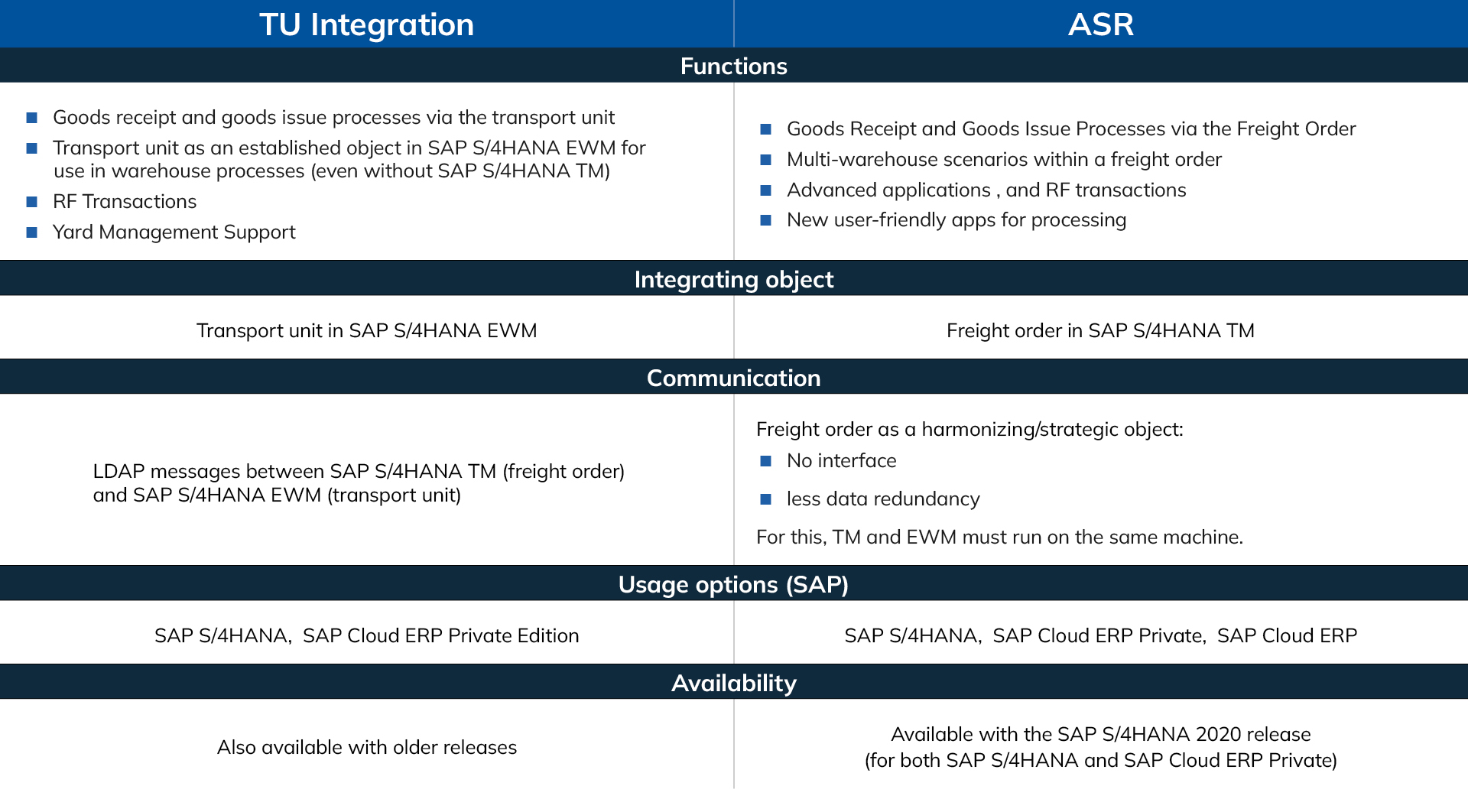
SAP has provided two scenarios for integrating transport and warehouse processes: the classic TU integration (Shipping and Receiving) and ASR (Advanced Shipping and Receiving). 

As an introduction, these are compared again in the following overview:

Table 1: Comparison of Integration Scenarios

But this poses a difficult question for many companies: How should they approach integration in the future?

Of course, it is not possible to make a blanket statement about which form of integration a company should choose. This depends on the requirements and processes that need to be implemented. This decision should be made after a thorough comparison of the requirements and the existing solution.  

This is made easier by the fact that both scenarios can run in parallel on a single system, allowing for a subsequent or phased migration. Consequently, different (or even the same) locations can run on SAP using different integration models and be migrated on an ongoing basis.  

An individual strategy can therefore be found for every company.

Theory vs. practice – Is the ASR as good as it sounds?

ASR promises simplified and harmonized integration between SAP S/4HANA TM and SAP S/4HANA EWM with user-friendly apps, clear status processing, and a central object (freight order) for a seamless end-to-end logistics process. 

Does it live up to its promise in practice? Is ASR already mature enough that implementation brings significant benefits to the company?  

To answer these questions, it is essential to take a look at SAP’s roadmap, as SAP continues to make significant progress: improvements and functional enhancements to the ASR integration are being delivered by SAP on an ongoing basis.

Release 2025

  • Cross-delivery packaging of HUs
  • Change management for deliveries distributed to EWM
  • Ad-hoc loading process: assignment of deliveries via RF loading to freight orders + loading of HUs without complete picking and packaging of the entire delivery
  • Automatic delivery split if the complete delivery was not loaded

Future Release

  • Ad-hoc loading of goods at staging area to the next freight order incl. resolving the assignment to existing freight orders
  • Paperless intracompany transports
  • ...

Product Vision

  • Scenario for planned cross-docking
  • Integration of containers and swap bodies
  • Row sequence integration for loading optimization
  • ...

Excerpt from the roadmap (SAP) for ASR

Are there still functional gaps in the ASR scenario? Yes. Is SAP closing them step by step? The roadmap provides the answer. However, not all issues have been addressed on the roadmap yet, and certain limitations remain during implementation:    

  • Decoupling/parallelizing processes when they are only partially relevant to SAP S/4HANA TM or SAP S/4HANA EWM 
  • In the event of late changes to transport planning in SAP S/4HANA TM, not all processes in SAP S/4HANA EWM are taken into account (wave formation, wave assignment, changes to gate assignment…)
  • Information transfer from TM and EWM to the delivery order ( ) is currently incomplete and is not updated (e.g., means of transport)
  • … 

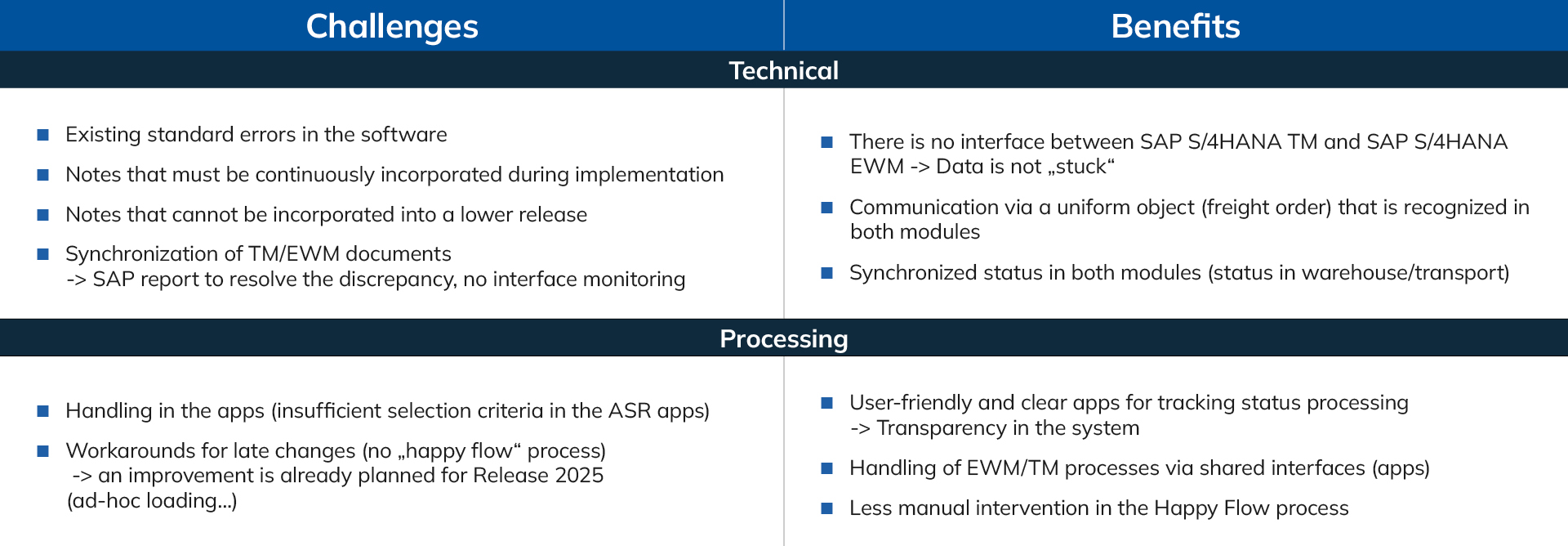
In addition to the functional gaps, there are other challenges associated with implementing ASR; at the same time, however, the scenario also offers significant advantages.

Table 2: Challenges and Benefits of an ASR Implementation

What is the conclusion?

Functional gaps, standard errors, synchronization issues, and opportunities for optimization in handling still exist. However, this is offset by the technical and functional benefits.  

Is there still room for improvement? The answer is clear, but with the ASR scenario, SAP has created a future-proof form of integration that reduces data redundancy, merges processes, and provides users with a unified overview of warehouse and transport processes.  

A migration or new implementation is therefore worthwhile, as ASR is now suitable for production use and forms the foundation for transparent and integrated end-to-end processes in warehousing and transportation.

Contact us! 

FAQs:

ASR is an SAP integration scenario that connects warehouse management (SAP S/4HANA EWM, Lean WM, etc.) with transportation management (SAP S/4HANA TM). It enables an integrated end-to-end process for goods receipt and goods issue processes, based on the freight order in SAP S/4HANA TM.

In the classical TU integration, the transportation unit in SAP S/4HANA EWM communicates with the freight order in SAP S/4HANA TM via LDAP messages. This means transportation and warehouse management use separate business objects that exchange data through interfaces at defined points in time. In the ASR scenario, by contrast, the freight order is used as a harmonizing object across both transportation and warehouse management, thereby reducing interfaces and avoiding data redundancy.

ASR provides a simplified and harmonized integration of warehouse and transportation processes in SAP S/4HANA. This is supported by user-friendly applications, clear status handling, and a centralized object (the freight order) that serves as the core entity for integrated processes.

Functional gaps such as the decoupling of warehouse and transportation processes, as well as handling late changes in transportation planning, still exist but are being gradually addressed by SAP. At the same time, there are technical challenges, such as standard integration issues and the need to apply SAP Notes, which can complicate implementation.

Yes, ASR is now suitable for productive use and provides a future-oriented foundation for transparent and integrated end-to-end warehouse and transportation processes. Despite remaining optimization opportunities, the technical and functional benefits outweigh the drawbacks.

Are you considering integrating SAP S/4HANA EWM and SAP S/4HANA TM in your company? abat can help you find the right scenario. Contact us!

Saskia Förster
+49 421 430460