Governance first: A joint HR-IT committee with clearly defined roles, decision-making authority, and escalation paths establishes clear lines of responsibility. A business owner must be designated for each HR process before go-live.

From SAP HCM to SuccessFactors: How to successfully transition to the new HR solution
Content:
Anyone still using SAP HCM in ECC today has long been aware of the deadline: Maintenance ends in 2027, and Extended Maintenance expires in 2030. While SAP HCM for S/4HANA (H4S4) provides some breathing room until 2040, it is explicitly a bridge solution with no further functional development. All innovations are flowing exclusively into SAP SuccessFactors; SAP’s cloud-first strategy is thus no longer just an announcement but a reality in practice. The question, therefore, is no longer “if” but “how” you will make the transition to the new solution.
We at abat AG have embarked on this journey ourselves, implementing SuccessFactors Employee Central, Recruiting, and Onboarding both in-house and in various client projects. In this article, we share what we’ve learned along the way: about migration paths, hybrid architectures, and the stumbling blocks that arise in almost every project.
Why is the transition from SAP HCM to SuccessFactors now inevitable?
The transition is inevitable because SAP will end maintenance for HCM in ECC operations in 2027, and Extended Maintenance will expire in 2030. While SAP HCM for S/4HANA provides some breathing room until 2040, it is explicitly intended as a bridge solution without further functional development.
All product innovations are now exclusively incorporated into SAP SuccessFactors. For companies using SAP HCM, this means that SAP’s “Cloud-First” strategy is no longer just an announcement but a reality, and the real question is no longer “if” but “how” the transition to the new solution will be managed.
What are the target architectures for integrating Employee Central and SAP HCM?
Before discussing tools, the target vision must be established. In practice, three approaches have emerged that differ in their degree of integration and target architecture.
Side-by-Side approach
In the side-by-side approach, SuccessFactors complements the existing SAP system. Talent modules such as recruiting, performance, learning, and onboarding run in the cloud, while master data, time management, and payroll remain in the legacy SAP system. Master data is synchronized bidirectionally.
Core-Hybrid approach
In the Core Hybrid approach, Employee Central becomes the leading HR system and thus the single source of truth. Master data is stored in the cloud and replicated by SuccessFactors to S/4HANA or ECC, while payroll and time management initially remain in the existing SAP system. Experience shows that this approach is the most commonly used implementation path.
Full-Cloud target state
The full-cloud target state moves all HR processes entirely to SuccessFactors, including payroll via Employee Central Payroll. Non-HR processes, such as finance, can continue to run in S/4HANA and are supplied with HR data from Employee Central.
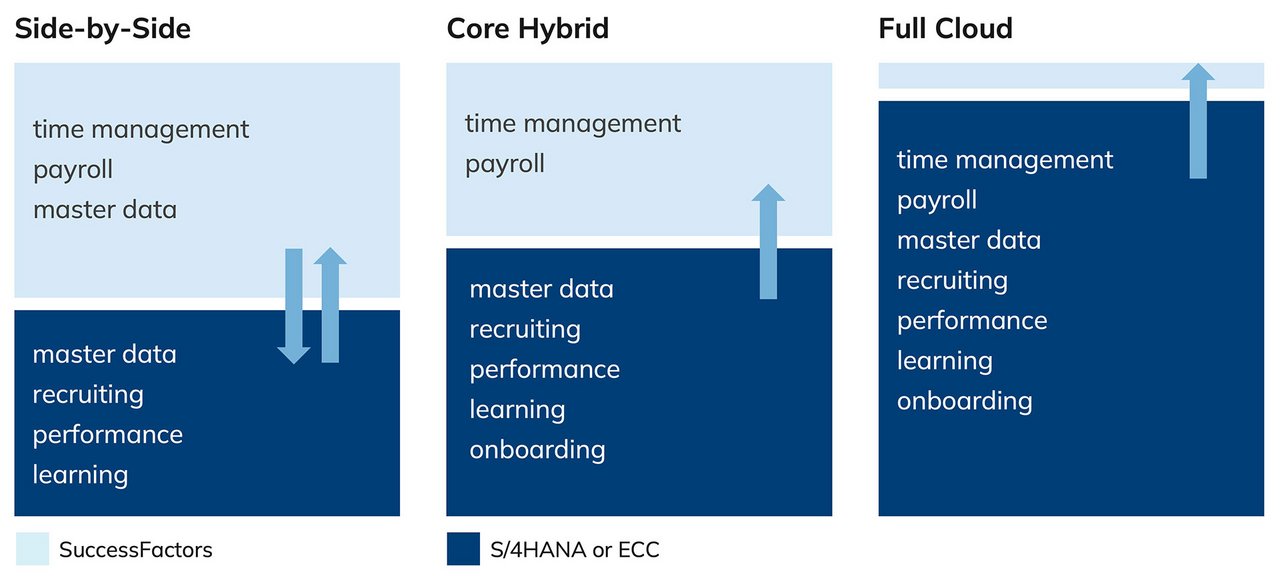
Which path is the right one depends heavily on the initial situation. Organizations with complex, established time and payroll processes may be better off with a hybrid model for the time being, although the full-cloud approach often remains the long-term goal.
How does the technical migration from SAP HCM to Employee Central work?
There is no standard technical path for migrating SAP HCM to SuccessFactors at the push of a button: this is a transformation, not a system change. The data models are fundamentally different. Infotype-based HCM data must be converted into Employee Central objects – namely, portlets and MDF objects – which requires mapping and harmonization; not all data is transferred on a 1:1 basis. Anyone planning the implementation as a pure system migration is underestimating the project from the outset.
For the initial data transfer at cutover, migration tools such as Infoporter or SAP Data Services are used. These convert infotypes into the target format of Employee Central and work with mapping and structure definitions that are consistent with the subsequent live integration. The migration is performed via CSV upload or API, but it is a one-way process: a one-time, one-way transfer without live integration.
For ongoing operations after go-live, the Business Integration Builder (BIB) handles continuous replication between Employee Central and the existing SAP system. The BIB is a configuration framework with centralized field and value mapping that also covers custom infotypes and supports replication scenarios. The configuration is more complex; in some cases, BAdI implementations are required.
Point-to-point integrations via RFC and IDoc now play a role only in a few cases – such as for Time and Payroll – and are no longer being strategically developed by SAP.
What did the transition to SuccessFactors look like specifically at abat AG?
Our internal implementation illustrates what such a process looks like in practice:
- June 2025: Go-live of Employee Central
- August 2025: Go-live of the Recruiting module and the digital personnel file
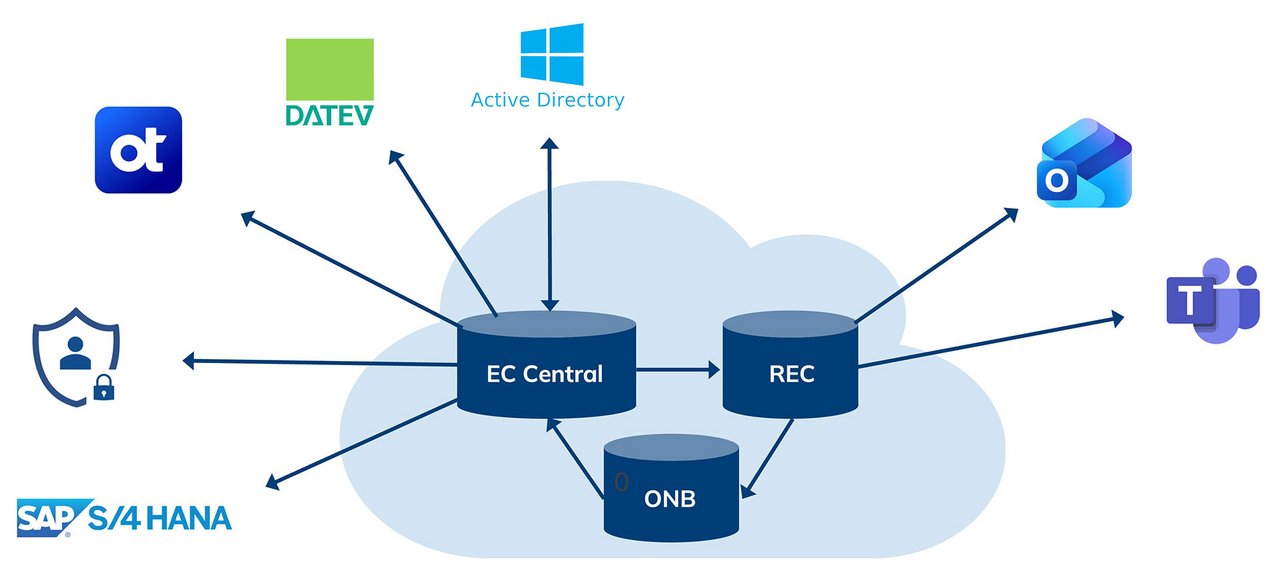
- Spring and Summer 2025: Interfaces to Active Directory and Identity Authentication Services, unidirectional connection to S/4HANA, and Employee Central Self-Service for all employees
- Next milestone: Rollout of the onboarding module
These stages illustrate a pattern we share with every client: A phased rollout with clearly defined go-lives is far superior to a “big bang” approach. Each phase provides insights for the next and minimizes risk.
Cloud projects often start with high expectations: seamless migration, immediate efficiency gains, reduced IT effort, and fast go-live dates. The day-to-day reality of the project looks different. Hybrid systems lead to friction, organizational resistance arises, technical complexity is underestimated, and change management turns out to be an ongoing challenge. Our key observation from many projects: The systems work, but the integration is underestimated. The replication layer between Employee Central and the target systems – such as S/4HANA for finance and time management – is the critical path. Errors there directly impact payroll, reporting, and the end-user experience.
What are the typical stumbling blocks during implementation?
The typical problems can be divided into three categories, all of which you should keep in mind at the same time.
Organizational
There is often a lack of clear ownership and process accountability, and project communication starts too late. When no one is responsible for the end-to-end process, silos form, and errors arise at the boundaries of those silos.
Technical
Here, replication errors in master data, overlooked custom fields, and poor test data management are the main issues. A real-world example: Job monitoring generates a log that no one checks; errors only become visible during the payroll simulation run.
Cultural
There is resistance to new user interfaces; HR and IT speak different languages; and training sessions are scheduled too late. Self-service features are only adopted once targeted training and clear instructions are available; the phrase “it’s faster to just send an email to HR” is a warning sign you should take seriously.
Added to this are typical weaknesses in the project workflow: overly optimistic assumptions about out-of-the-box capabilities (“SuccessFactors can definitely do that…”), incomplete process definitions, a missing end-to-end data model, workarounds intended as temporary solutions but which become permanent, interfaces tested in isolation rather than within the overall process, and underestimated cutover efforts.
What makes a SuccessFactors project successful?
Data quality before migration: Cleaning up master data before migration drastically reduces integration and payroll errors. There’s no better time to clean things up than before migration.
Take integration seriously: Mapping and replication must be tested in detail and end-to-end, not just in isolation. The replication logic must be fully documented – including custom fields, BAdIs, fixed values, and value mappings – in a way that even non-technical stakeholders can understand. Automated alerts for replication errors should be set up from the very beginning, not just after the first payroll incident.
Adopt a “standard-first” mindset: Consistently align your processes with the SuccessFactors standard. Custom solutions should remain the justified exception, which reduces complexity and maintenance costs in the long term.
Change management from Day 1: Involve business units, HR, and executives from the very beginning through communication, training, and clear expectations. A pilot group validates the solution before a broad rollout.
Think about operations: Plan for monitoring and a hypercare phase after go-live with sufficient resources. Go-live is not the end of the project, but the beginning of operations.
Conclusion: transformation, not a system change
The transition from SAP HCM to SuccessFactors is feasible, but it is a transformation, not a system change. Technology is the enabler here, not the driver. Success comes from clear processes, clean data, and consistent change management. The biggest problems don’t arise in the cloud itself, but between the systems.
Those who approach the platform migration in a structured manner now will not only secure their future ahead of maintenance end dates, but also gain modern self-service capabilities, a contemporary user experience, and a platform in which SAP is investing all of its HR innovation. Now is the right time to plan your own path.
abat AG supports companies on precisely this journey – from the initial decision on the target vision through the technical migration to stable operations after go-live. As an SAP consulting firm with first-hand project experience from the internal implementation of Employee Central, Recruiting, and Onboarding, we know the pitfalls firsthand – not just in theory.

FAQs:
1. What is the difference between Side-by-Side and Core Hybrid?
In the side-by-side approach, SuccessFactors only supplements the existing SAP system with talent modules such as Recruiting or Learning, while master data and payroll remain in the old system. In the Core Hybrid approach, however, Employee Central becomes the primary source of master data, from which data is replicated into the existing SAP system.
2. What does the Infoporter do during the migration to Employee Central?
3. What is the Business Integration Builder (BIB) used for?
4. By when do I need to switch from SAP HCM to SuccessFactors?
5. How long does the implementation of Employee Central typically take?
6. Is point-to-point integration still a viable option?
Contact our expert
