Initial Situation:
No automated guided vehicle (AGV) system, no route control. At the start of production, all required materials were manually delivered to the production line—all at once. The result: space constraints directly at the production line, disorganized staging areas, and a high level of manual effort for replenishment.
Route trains in production: how SAP EWM and SAP S/4HANA Manufacturing Logistics are rethinking intralogistics
Content:
From manual processes to system control
Production doesn’t wait. If a component is missing from the assembly line, it’s not just a single work step that grinds to a halt: costs rise, on-time delivery comes under pressure, and in the worst case, the entire line comes to a standstill. At the same time, manufacturing is becoming increasingly complex—due to more product variants, higher production volumes, and ever-tighter production cycles. Especially when it comes to material supply, therefore, the process is not determined solely by the automated guided vehicle (AGV) on the shop floor. What matters most is whether picking, loading, and supplying the line are managed reliably, transparently, and on time. What in many plants still relies on lists, verbal instructions, and experience-based knowledge can be systematically integrated into SAP.
For system-supported production supply via automated guided vehicles (AGVs), SAP offers two solutions: Distribution Equipment as a solid foundation within SAP EWM and the more comprehensive add-on SAP S/4HANA for Manufacturing Logistics for more complex requirements. With regard to Distribution Equipment, abat supported SAP’s EWM development team in making this functionality available in the standard EWM system. We are therefore familiar with the solution not only from projects but also from its development within the standard system. The crucial question, then, is not whether a route train makes sense. It is: How much control does your production supply require, and which SAP variant matches your level of maturity? To contextualize this decision, it’s worth first taking a look at the physical process that both SAP approaches digitally map.
What is a route train, and why is it relevant?
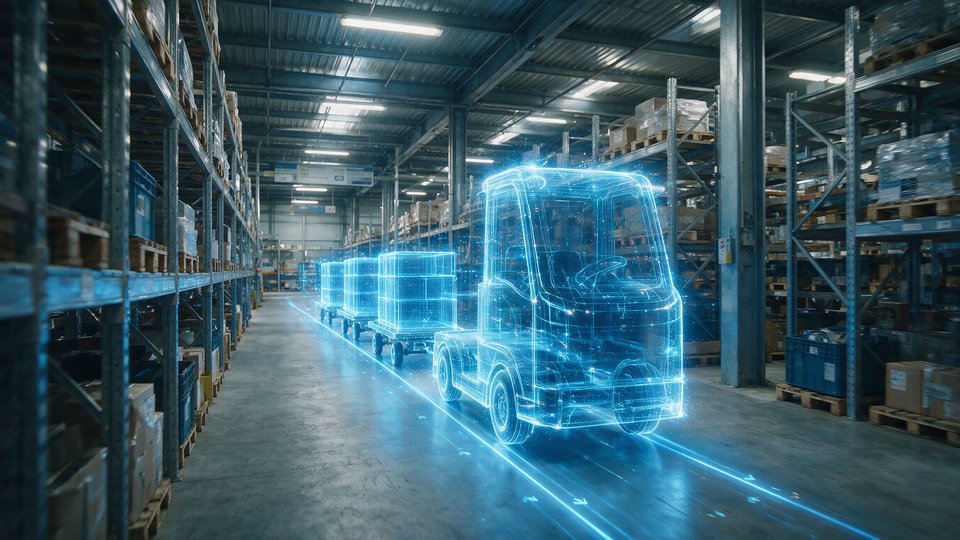
The route train (also known as a tugger train) is a proven method for production supply in the automotive and mechanical engineering industries. A tractor unit pulls several trailers carrying small load carriers (SLCs) or large load carriers (LLCs) along a fixed route through warehouses and production halls.
Similar to a bus route network, the train stops at defined production supply areas (PSAs), delivers materials, picks up empty containers, and returns to the loading zone. The model is efficient. The challenge until now has been that this physical process was often carried out manually, without system support, without real-time transparency, and without seamless integration into the warehouse management system.
This is exactly where SAP comes in. The two solution approaches differ in scope and system requirements. A project from the aerospace industry illustrates just how significantly this lack of system support impacts day-to-day operations.
Case study: automated guided vehicle (AGV) in the aerospace industry
Solution:
Introduction of the route train with Decentral EWM in S/4HANA 2021 and SAP S/4HANA for Manufacturing Logistics (MFG) 2111. Materials from three warehouse sources (automated small-parts warehouse, manual warehouse, automated pallet warehouse) are now provided in a coordinated manner: The automated guided vehicle (AGV) handles the initial stocking of the bin racks at the line and then replenishes them on demand via JIT replenishment. Only what is currently needed is delivered to the line. No excess inventory, no space shortages. In addition, custom SAPUI5 dashboards were developed that transparently display parts due for call-off by production line.
Result:
The system now specifically supplies the bin racks on the production line and stocks individual production lines during initial startup – all SAP-controlled.
Technology:
Decentral EWM • SAP S/4HANA • SAP S/4HANA for Manufacturing Logistics (MFG) • Fiori App My Tours • SAPUI5 (Custom Dashboards).
This example illustrates that the automated guided vehicle (AGV) only becomes a reliable supply process when the material flow is also managed systematically. To this end, SAP offers two complementary solutions.
Two variants: Distribution Equipment vs. route train (MFG)
SAP offers two technically related but functionally distinct approaches to system-supported route train operations. Both are based on process-oriented warehouse control (POSC) in SAP EWM. The route train (MFG) builds directly on Distribution Equipment and extends it with its own route model.
This common foundation explains why both methods can be combined and expanded step by step. The differences lie primarily in planning, scheduling, and transparency.
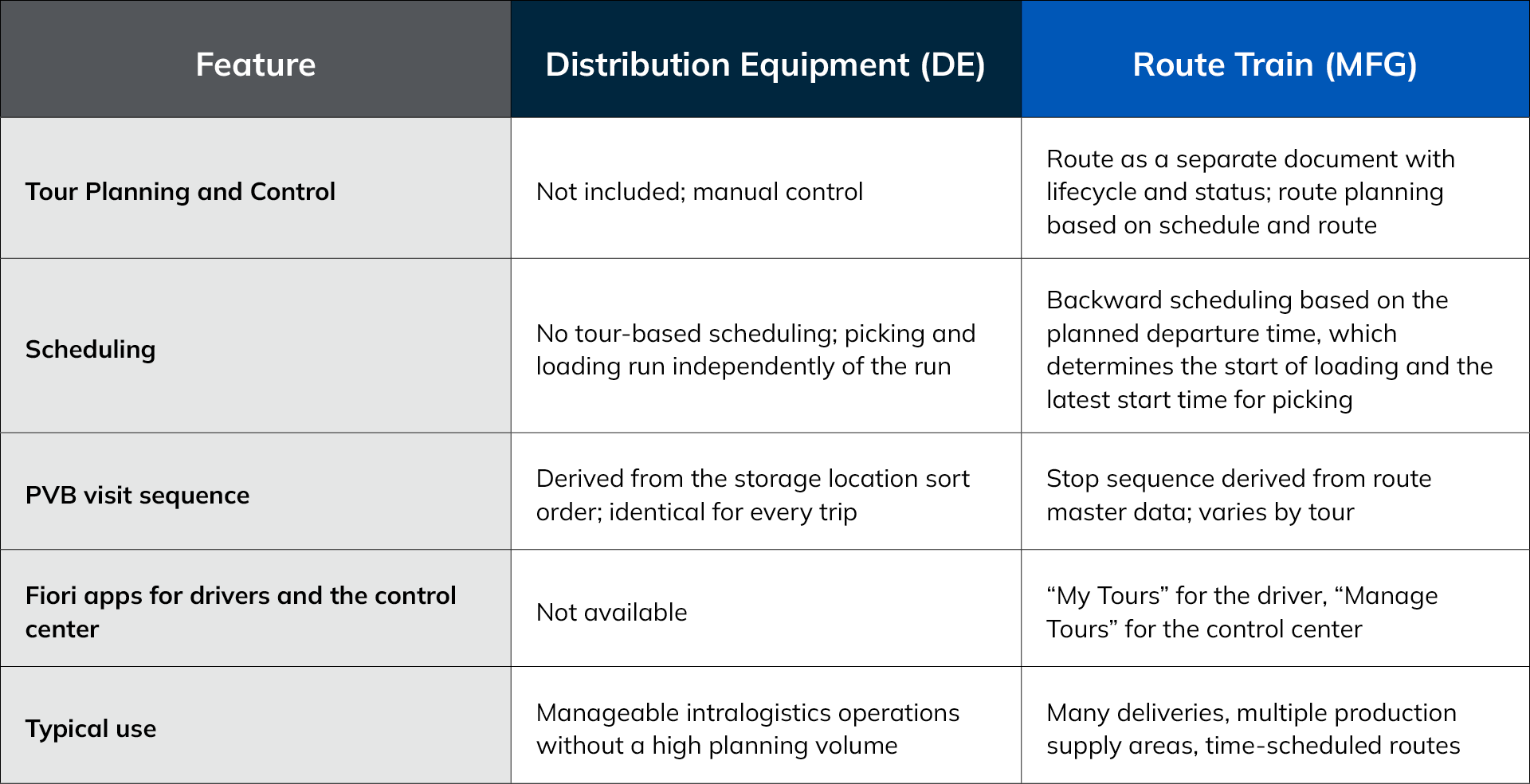
Table 1: Comparison of Distribution Equipment and Route Trains (MFG)
Choosing the right option
Distribution Equipment is suitable for companies seeking a quick, easy-to-implement entry point into system-supported production supply. The standard EWM process covers the essential steps: picking, staging, loading, and unloading. It guides employees all the way to the loading position in the rack. Inventory is thus traceable from the storage location to the production line. No additional add-on is required for this.
Routenzug (MFG) is recommended as soon as higher delivery volumes, time-controlled routes, multiple production order units (PVBs), and a control center with real-time visibility are required. The Manufacturing Logistics add-on supplements the base system with comprehensive route planning, dedicated Fiori apps, and system-guided loading and unloading.
However, the decision on which variant to use is based not only on the list of features but also on the interplay between plant layout, delivery frequency, and existing EWM processes.
abat’s practical experience
abat has successfully implemented both variants for customers, both with S/4HANA 2021 Decentral EWM and with Embedded EWM in SAP S/4HANA. Our consultants support you from the variant selection process through implementation to live operation.
- Distribution Equipment: Suitable for customers with compact production layouts and manageable route volumes; quick to implement; closely aligned with the EWM standard
- Route Train (MFG): Used by customers with high delivery volumes, time-controlled routes, and multiple PVBs; offers maximum process integration and transparency
How the solution works
A look at the common underlying process first reveals what both variants have in common before the differences in control become apparent.
Process overview
The system-supported route train process consists of eight steps, from the triggering of demand to the train’s return to the starting point:
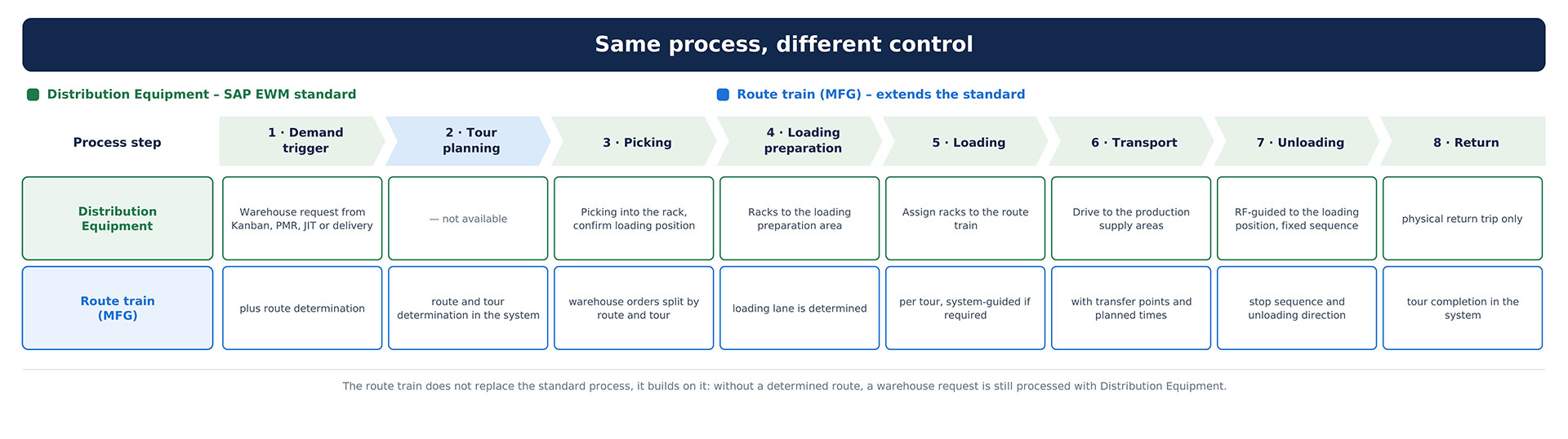
Figure 1: Same Process, Different Control. Production Supply via Route Train: A Comparison of Distribution Equipment and Route Train (MFG)
Both variants follow the same physical logistics chain: Material is picked, prepared for loading, loaded onto the automated guided vehicle, transported to the production supply areas (PVB), and unloaded there. Picking takes place in racks – that is, distribution aids divided into compartments – which travel on the trailers. The physical logistics chain is thus the same. The key difference lies in how the system manages sequence, deadlines, and responsibilities.
The difference lies in the sequence
Distribution Equipment derives the sequence of unloading steps from the storage location sorting. It is therefore identical for every trip; the process does not provide for route-dependent stop sequences. Route planning and capacity utilization remain in human hands.
The route train (MFG), on the other hand, stores a fixed sequence of stops for each route and automatically determines the route and tour. As a result, different tours serve the same supply areas in different orders. Picking is also controlled: the loading lane determination process specifies which loading lane the racks for a tour will be consolidated on.
The system calculates backward from a tour’s scheduled departure time: Based on loading and picking durations, it determines the latest time the picking wave must start so that the train departs on time. The schedule thus becomes a deadline for the warehouse.
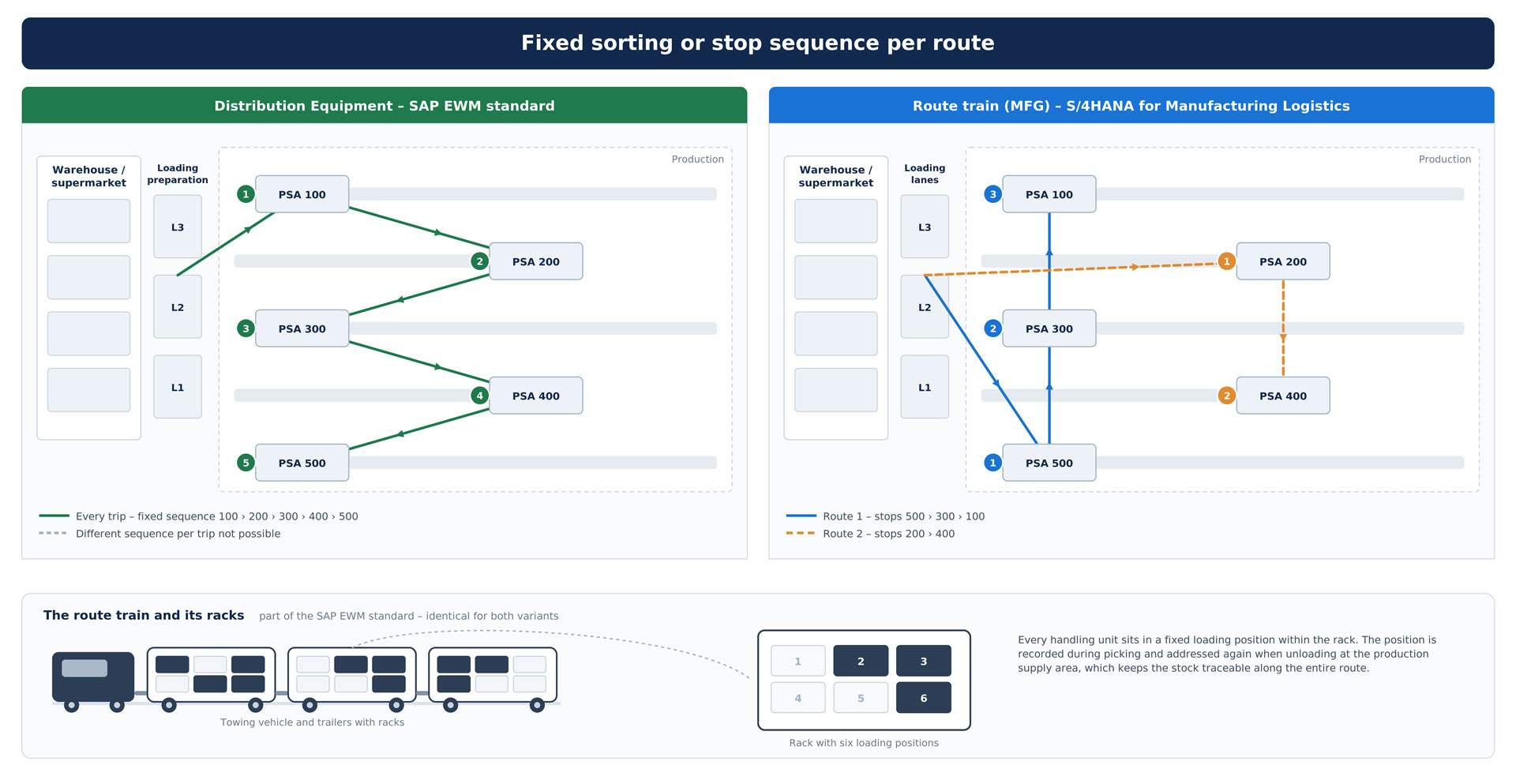
Figure 2: Same layout, same production supply areas. Distribution Equipment follows the same sequence on every round, derived from the storage location sorting, while the route train (MFG) follows its own stop sequence for each route
A prerequisite for this is route planning. Without a determined route, a warehouse request is not ready for a tour and continues to run through the Distribution Equipment process. Both procedures thus coexist in the same warehouse: The route train is not a replacement, but rather an expansion built on the same foundation.
This is most noticeable for the driver. Without system support, he works with a paper list and verbal instructions. Distribution Equipment alone replaces both: It guides him through the unloading process via an RF device, he confirms the production supply area, and is directed to the picking location in the rack. What’s missing there is an overview of the tour as a whole. The route train (MFG) provides this view with the Fiori app “My Tours,” designed for a screen on the route train: It displays the train graphically with all stops on the route, which handling units are to be unloaded at each stop, the unloading direction for each stop, and progress – including the empty containers being carried. Confirmation is still done via RF. For warehouse management and scheduling, Manage Tours comes into play: create routes, assign loaders, track the loading plan and status, and close routes – without phone calls or follow-up inquiries.
These different control mechanisms have tangible effects on day-to-day operations – for supplying the production line as well as for drivers, warehouse management, and scheduling.
The concrete benefits of the route train
The shift from manual route train processes to a system-supported solution has a direct impact on operations. The following three aspects illustrate why the digitization of the route train is far more than just replacing paper lists.
Production supply that doesn’t depend on individuals
In manual operations, whether materials arrive at the production line on time depends on how things go that day: an unclear shift handoff, a list that was left behind, or the wrong quantity being picked. When demand is entered into the system, however, it generates orders for the warehouse and guides employees step by step – using a scanner – all the way to the production supply area. Every production line is supplied according to the same rules, regardless of who is on duty, and every step remains traceable.
Real-time transparency into every material flow
In SAP EWM, what was previously a black box is now fully visible: which material is on which trailer, which PVBs have already been supplied , and how far along the route is. Warehouse managers and production supervisors can view the status of every route in real time, without having to check with the driver or shift supervisor.
Scalability Without Increased Complexity
More variants, more parts, more supply areas: What eventually breaks down when managed manually scales seamlessly within the system. Routes and tours can be flexibly adjusted without changing the core process. This is a decisive advantage in growing or changing manufacturing environments.
For these advantages to take effect, the system landscape, process maturity, and deployment scenario must align with the selected configuration.
Prerequisites and classification
Starting with SAP S/4HANA 1909, Distribution Equipment is part of the standard SAP EWM and runs on both Embedded EWM and Decentral EWM based on SAP S/4HANA. The route train (MFG) also requires the SAP S/4HANA for Manufacturing Logistics add-on and is not a standalone system, but rather an extension that builds directly on SAP EWM.
Particularly relevant for companies with...
- a high volume of components in manufacturing (automotive industry, mechanical engineering, electronics manufacturing, aerospace)
- complex plant layouts with multiple production supply areas
- an existing or planned automated guided vehicle (AGV) operation without system support
- an upcoming S/4HANA migration involving the implementation of EWM
- the goal of systematically digitizing manual processes in intralogistics
For these companies, the tugger train is therefore not an isolated logistics issue, but a useful lever for systematically digitizing production supply.
Conclusion: evolving the route train from a means of transport to a control process
The tugger train is a proven tool for production supply. However, it only realizes its full potential when material requirements, order picking, loading, and line supply are seamlessly integrated within SAP EWM. This transforms a process heavily reliant on experience and manual coordination into a transparent, reproducible process.
Whether Distribution Equipment is sufficient as a standard-based entry point or whether the route train with SAP S/4HANA for Manufacturing Logistics makes more sense depends on the individual scope of supply and the required level of control. Both approaches lay the foundation not only for reliably handling material flows but also for specifically optimizing them based on route, time, and utilization data.
Those who systematically integrate their production supply today not only increase supply reliability on the production line but also lay the groundwork for managing their intralogistics in a scalable manner as product variety and operational dynamics increase.
abat supports you from the variant selection process through to the go-live phase
FAQs:
1. What is the difference between Distribution Equipment and the Route Train (MFG)?
Distribution Equipment is the EWM standard for physical route train operations (picking, loading, unloading). The route train (MFG) is technically built on this foundation and supplements it with a standalone route model featuring automatic route planning, Fiori apps, and system-guided control.
2. What are the SAP system requirements for these variants?
3. What is SAP S/4HANA for Manufacturing Logistics?
4. Can the solution be implemented in phases?
5. Can Distribution Equipment and Route Train (MFG) be operated in parallel?
Contact our expert