Credit segments instead of simply carrying over old areas unchanged: An existing credit control area does not prove that an identical credit segment makes sense in the target structure. Anyone who mechanically transfers historical structures carries old special cases over into the new model.

SAP Credit Management in S/4HANA: More than just a technical migration
Content:
If you’ve been using the classic SAP Credit Management (FI-AR-CR) system, the switch to SAP S/4HANA changes more than just the technical foundation. In S/4HANA, FI-AR-CR is replaced by SAP Credit Management (FIN-FSCM-CR). Credit-related data is managed at the business partner level, risks are controlled via credit segments, and exceptions are documented in a traceable manner.
It is therefore crucial how Finance, Credit Management, Sales, and IT jointly shape the future process. This article outlines the decisions that must be made prior to configuration and explains how to ensure the technical soundness of migration, data reconciliation, and routine operations.
Credit Management in a constant conflict of interests
Credit management must balance two competing interests. Sales wants to deliver to customers quickly, avoid delivery blocks, and maximize revenue potential. At the same time, Finance and Credit Management must limit bad debt, uncontrolled limit exceedances, and untraceable exceptions.
If clear roles are lacking, shadow processes can emerge: approvals are handled informally, limits are changed without sufficient oversight, and decisions are recorded only in emails or individual files. In hindsight, it then becomes difficult to trace who accepted which risk and for what reason.
SAP Credit Management (FIN-FSCM-CR) consolidates a business partner’s credit-related obligations from connected applications into a credit exposure and checks them against the current credit limit. Departments such as Sales, Shipping, and Financial Accounting can contribute to this process. However, a centralized view alone does not resolve unclear responsibilities or conflicting data.
The key question, therefore, is not: How do we migrate our credit control areas? Rather: Which credit policy should apply in the future – in which process, based on which data, and with whom responsible?
The challenge: Old structures do not automatically fit into the new model
The change is more than just a new name. Instead of being customer-oriented, SAP Credit Management works with business partners and credit segments. Three points deserve special attention here:
Data issues become apparent: Credit-related information will now be associated with the business partner, and risk classes will be maintained once per customer for all segments. Unclear customer identities, duplicates, or conflicting risk classifications will become apparent at this stage, if not sooner.
Check the credit exposure in a before-and-after comparison: During a system conversion, comparing open customer order – delivery, and invoice values is particularly challenging. Historical comparison values should be backed up before the conversion. If the document currency differs from the credit control area currency or credit segment currency, conversions at the current daily exchange rate can generate additional discrepancies.
These challenges cannot be resolved through technical settings alone. Before implementation, companies must clarify which credit risks they are willing to accept, who is responsible for making decisions, and how exceptions will be handled. A shared business vision provides the foundation for this.
Designing SAP Credit Management: First the vision, then the configuration
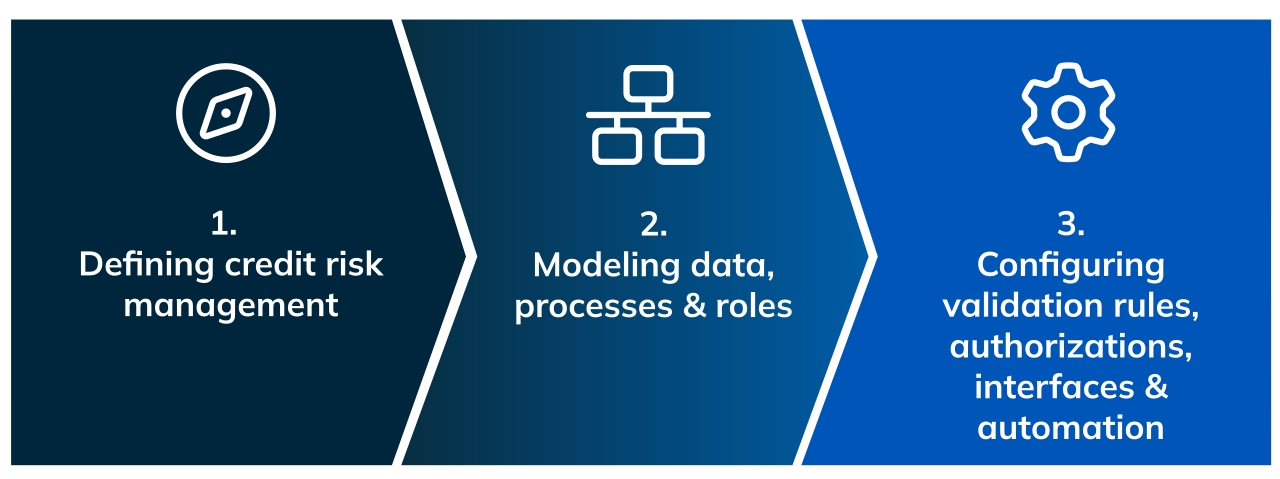
A clear sequence has proven effective. First, the company decides how it wants to manage credit risks. It then models data, processes, and roles. Only then are validation rules, authorizations, interfaces, and automation configured. This ensures that technology does not dictate credit policy – but rather the other way around.
In practice, this means:
- Tailor segments to business needs: Review every existing credit control area. Is there a verifiable reason for making independent risk or limit decisions, or is an evaluation option all that’s needed?
- Manage exceptions as a regulated process: Documented Credit Decisions (DCDs) consolidate the data behind a credit hold and record who approves or rejects a document and for what reason. To do this, define approval limits, processing times, delegation rules, and required supporting documentation.
- Treat credit exposure as a separate work package: Back up comparative data before the cutover, i.e., the go-live. Map historical customers and credit control areas to the target model and compare the values by business partner, credit segment, currency, and exposure category – such as open orders or receivables. Every discrepancy must have a traceable cause; permissible tolerances must be approved by the business unit.
Ensure a successful migration and manage credit management during operations
For the conversion of a single-system landscape, the SAP task list specifies the technical steps and their sequence. However, it does not replace business-specific project planning. Our recommendation is therefore: Combine technical migration steps with business-specific quality gates – that is, verifiable approval criteria. This ranges from the confirmed target state and data readiness to exposure reconciliation, business acceptance, and handover to regular operations.
A technically successful migration result is not sufficient for go-live approval. Finance, Credit Management, Sales, and IT should use critical end-to-end scenarios to confirm that credit checks, blocks, approvals, and exceptions function as intended from a business perspective. Suitable scenarios include, for example, those involving high limit utilization, foreign currencies, or late payments. Critical exposure discrepancies must not remain unresolved; causes and accepted tolerances must be documented.
After go-live, metrics such as DCD turnaround time, block rate, and unresolved exposure discrepancies help identify anomalies. A high block rate is not automatically good or bad: it can indicate effective risk management, but it can also point to inappropriate limits or poor master data. Each key metric therefore requires a designated person in charge, a review schedule, and a corresponding course of action.
Conclusion: Credit management is determined by the target state
SAP Credit Management lays the foundation for more centralized and traceable credit management. Whether this results in a robust process depends on credit policy, data quality, standardized exceptions, and business-validated workflows. Migration is therefore not complete with the technical transition alone. Only a traceable data reconciliation, a joint acceptance process, and management during routine operations can combine fast customer delivery with controlled credit risk.

FAQs:
1. What changes will the transition to SAP S/4HANA bring to credit management?
The traditional FI-AR-CR credit management system will be replaced by SAP Credit Management (FIN-FSCM-CR). Instead of being customer-oriented, the new solution works with business partners and credit segments. Credit-related data is managed centrally at the business partner level, and exceptions are documented in a traceable manner.
2. Can existing credit control areas be easily converted into credit segments?
3. Why is a successful technical migration not enough for go-live?
4. How can exceptions to credit blocks be managed in a traceable manner?
5. Is a high rejection rate after go-live a good or bad sign?
Contact our expert
